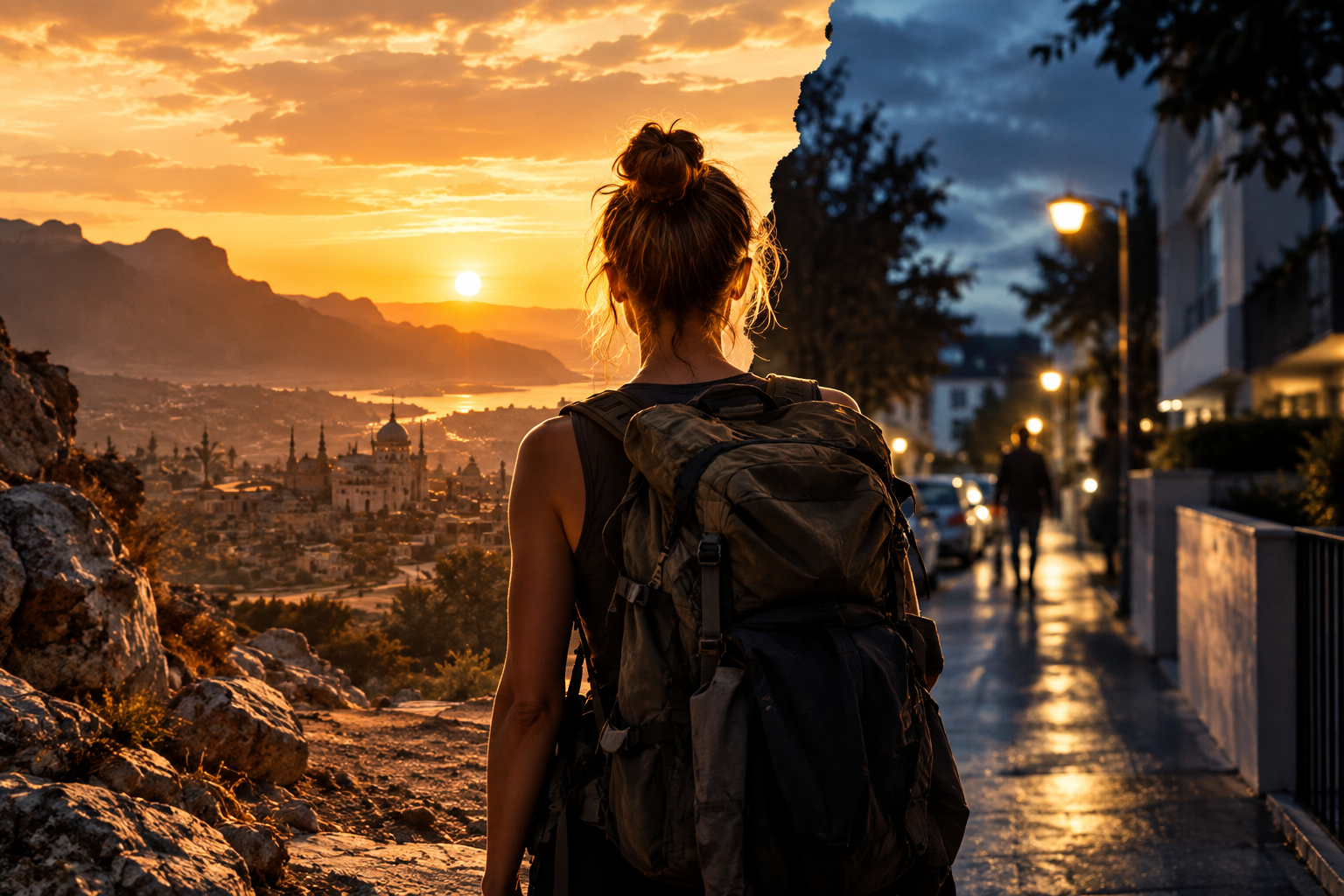
When a woman travels alone with a backpack, sleeps in a tent, walks through unfamiliar cities and visits countries that many people may know only from the news, there is often a familiar reaction:
“Well, she puts herself in dangerous situations.”
Maybe.
But what does it actually mean to put yourself in danger?
And why do we so quickly think this way about a woman travelling alone, while we rarely think the same way about a woman who has lived in the same place for years?
I have been travelling for years, and I have experienced situations I would rather not experience again. Situations where an ordinary day suddenly became unpredictable. Situations where you have to decide very quickly whether to stay or leave.
I deliberately don’t want to say exactly where these things happened or describe what happened in detail.
Not because there is nothing to tell.
But because the real story is something else.
Danger Doesn’t Only Exist in Unfamiliar Places
We tend to associate danger with the unfamiliar.
With a country where we don’t speak the language. With a city whose streets we don’t know. With a remote place where we don’t know anyone. With a woman travelling alone.
And yet something strange happens when we are in familiar surroundings.
The more familiar our environment is, the less we tend to think about the possibility that something could happen there that we cannot control.
A woman walks home alone in the evening.
She waits at a bus stop.
She gets into a taxi.
She walks through a parking garage.
She meets someone new.
She goes for a run.
She cycles home.
She goes to a party.
She lives in a home where she normally feels safe.
None of these things sounds like an extraordinary adventure.
And yet completely ordinary situations can suddenly take a different turn.
That is something travelling has repeatedly made clear to me:
Safety does not depend only on whether we are at home or on the other side of the world.
“She Should Have Known Better”
Perhaps it is comforting to believe that dangerous situations are usually predictable.
Because then we can tell ourselves that they won’t happen to us.
I wouldn’t go there.
I wouldn’t walk around alone at night.
I would never travel to that country.
She should have known it was dangerous.
It creates a seemingly simple order.
If you are careful enough, you will stay safe.
And if someone ends up in a dangerous situation, they must have done something wrong.
But reality isn’t that simple.
Of course, some choices increase risk. Of course, we can research places, avoid certain areas and take sensible precautions.
We should.
But even the most careful and attentive person can be in the wrong place at the wrong time.
You cannot always recognize a situation before it becomes dangerous.
And that applies to far more than travelling.
When a Woman Travels Alone, Her Decisions Become More Visible
When I travel, I notice how quickly responsibility for a dangerous situation can be placed on the traveller herself.
After all, she decided to go there.
She decided to travel alone.
She decided to sleep there.
She decided to take that route.
And when something happens, it can very quickly create the impression that she somehow chose the danger as well.
But a woman who becomes the victim of violence in her own city didn’t choose that either.
A woman walking home after work didn’t choose for someone to follow her.
A woman who suddenly finds herself in a dangerous situation in a familiar environment didn’t automatically do anything wrong.
We have control over our own decisions. But we do not have complete control over what other people do or how a situation develops.
That distinction matters.
And perhaps it is something we sometimes forget when we talk about women travelling alone.
I Am Not Looking for These Situations
I want to make that very clear.
I don’t travel because I am looking for danger.
I don’t want to experience situations like that all the time.
I don’t want to prove how much I can endure. And I don’t want to collect increasingly dangerous stories just so I can say that every trip was more extreme than the one before.
I travel because I am curious about the world.
I am interested in people, stories, landscapes and places. I like travelling with very little luggage. I like the freedom of not knowing exactly what the next day will look like.
But freedom does not mean being invulnerable.
And experience does not mean that nothing can happen to you.
Perhaps experience simply means that, over time, you recognize certain warning signs earlier.
You notice when the atmosphere changes.
You learn to trust your own instincts a little more.
And you understand when it is time to leave.
But Don’t We Know Which Countries Are Dangerous?
Of course we can inform ourselves.
And we should.
There are official travel advisories, safety levels, regional warnings and recommendations from authorities. They can provide important information about risks that currently exist in a country or a particular region.
But even here, it is worth looking a little closer.
There is no single worldwide safety level that works according to exactly the same rules everywhere.
Different governments use different systems and categories. Some use several levels of travel advice, while others distinguish more strongly between general travel advice, warnings and specific regions. Within the same country, the assessment can also vary considerably from one area to another.
That matters because an entire country does not necessarily have the same security situation everywhere.
A high safety warning does not automatically mean that every part of a country carries the same level of risk.
And a lower warning does not mean that every street, every situation and every hour of the day is automatically safe.
So simply reading:
“This country is dangerous”
isn’t always enough.
A more useful question is:
Why is there a warning?
Is it because of violent crime? Terrorism? Kidnapping? Political unrest? Natural disasters? Border areas? Or something completely different?
And, perhaps most importantly:
Where exactly does the risk exist, and how current is the information?
A safety level is guidance.
It is not a personal guarantee.
And Then There Are the Media
News also shapes the way we perceive how dangerous a place is.
That is understandable.
When something terrible happens in a country, it gets reported. If the situation deteriorates, the same images and stories may appear on our screens for days.
It can easily create the impression that an entire country consists of situations like these.
On the other hand, someone who actually lives there might say:
“Everything is completely normal where I live.”
That can also be true.
It doesn’t necessarily mean that one side is right and the other is wrong.
It shows that a country can contain many completely different realities.
The news shows us events.
Official travel advice describes certain risks.
People living there experience their everyday lives.
And our own situation as travellers is something else again.
That is why I would not treat either a headline or one person’s personal experience as the complete picture.
I would compare several sources and look more closely.
Not simply ask:
“Is this country safe?”
but:
“What risks currently exist where I actually want to go, and how am I travelling?”
Someone staying in a hotel and using organized transport may face a very different situation from someone travelling alone with a backpack and spontaneously putting up a tent somewhere.
Safety is not simply a characteristic of a country.
It also depends on location, circumstances, behaviour, timing and individual situation.
We May Overestimate How Safe Our Familiar Life Is
Perhaps this is the part I think about most.
I don’t want to make anyone afraid of travelling.
And I don’t want to suggest that danger is waiting everywhere.
Quite the opposite.
I simply think we should be more careful about explaining other people’s safety to them.
A familiar place feels safe because we know it.
We know the streets. We know where the shops are. We know the public transport system. We know how to get home.
That familiarity can be incredibly reassuring.
But familiarity is not the same thing as safety.
Situations can escalate in a city we know well.
Someone can find themselves in the wrong place at the wrong time in a completely familiar environment.
A perfectly ordinary day can suddenly turn out very differently from how it looked that morning.
The difference is perhaps that we think about this much less when we are at home.
We leave our homes in the morning and usually assume we will simply return in the evening.
When travelling, however, we become much more aware that we cannot control everything.
We don’t know the surroundings.
We don’t know the people.
We don’t know all the local circumstances.
And because of that, we may feel more vulnerable.
But the world hasn’t suddenly become more dangerous simply because we left our familiar surroundings.
We are simply more aware of our own uncertainty.
Perhaps “She Is to Blame” Is Too Simple
When someone finds themselves in a dangerous situation, saying “She should have known better” gives us a simple explanation.
It makes us feel that we would be safe ourselves if only we made the right decisions.
But life doesn’t always work that way.
Of course, we can reduce risks.
We can research.
We can take warnings seriously.
We can avoid certain places.
We can pay attention to our surroundings.
We can think about how we would get out in an emergency.
But we cannot control what happens five minutes from now.
And that applies to travellers just as much as it applies to people who have lived in the same place for decades.
Perhaps we should therefore sometimes ask less:
“Why was she there in the first place?”
And instead ask:
“Could she really have known beforehand what was going to happen?”
Sometimes the honest answer is no.
I Don’t Want to Become Stronger All the Time
I think long-term travel also changes the way you see your own resilience.
You experience things that you might once have considered unimaginable.
And eventually you realize:
I can handle more situations than I thought I could.
But I don’t want to turn that into the belief that I therefore have to handle everything.
I don’t need to become braver all the time.
I don’t need to endure more and more.
And I don’t want to believe that surviving one dangerous situation means the next one will turn out just as well.
Experience can help.
It can make us more observant.
It can teach us when to turn around.
But experience does not make us invulnerable.
Perhaps part of becoming experienced is accepting that we cannot control everything.
Safety Means Something Different to Me Now
I used to think safety meant that nothing happened.
Today I see it differently.
Safety doesn’t mean that the world is predictable.
For me, it means staying aware, informing myself, knowing my boundaries and taking a situation seriously when something changes.
And sometimes it simply means leaving.
Not because you are weak.
Not because you cannot handle the world.
But because you don’t have to prove that you can survive a dangerous situation.
I want to keep travelling.
Not because I believe nothing can happen to me.
But because I have accepted that you cannot predict everything.
I can try to stay aware.
I can inform myself.
I can weigh risks.
I can listen to my instincts.
And when something changes, I can change direction.
Perhaps that is one of the most important things travelling has taught me:
We have more control over our decisions than we have over the world in which those decisions take place.
And perhaps that is exactly why we should be careful when judging other people.
A woman with a backpack who finds herself in a dangerous situation somewhere in the world has not automatically put herself there.
Just as a woman walking home in her own city has not automatically chosen danger either.
We can be careful.
We can make sensible decisions.
We can reduce risks.
But we cannot predict everything.
And perhaps that is something that connects all of us – whether we travel the world with a backpack or have lived on the same street for twenty years.