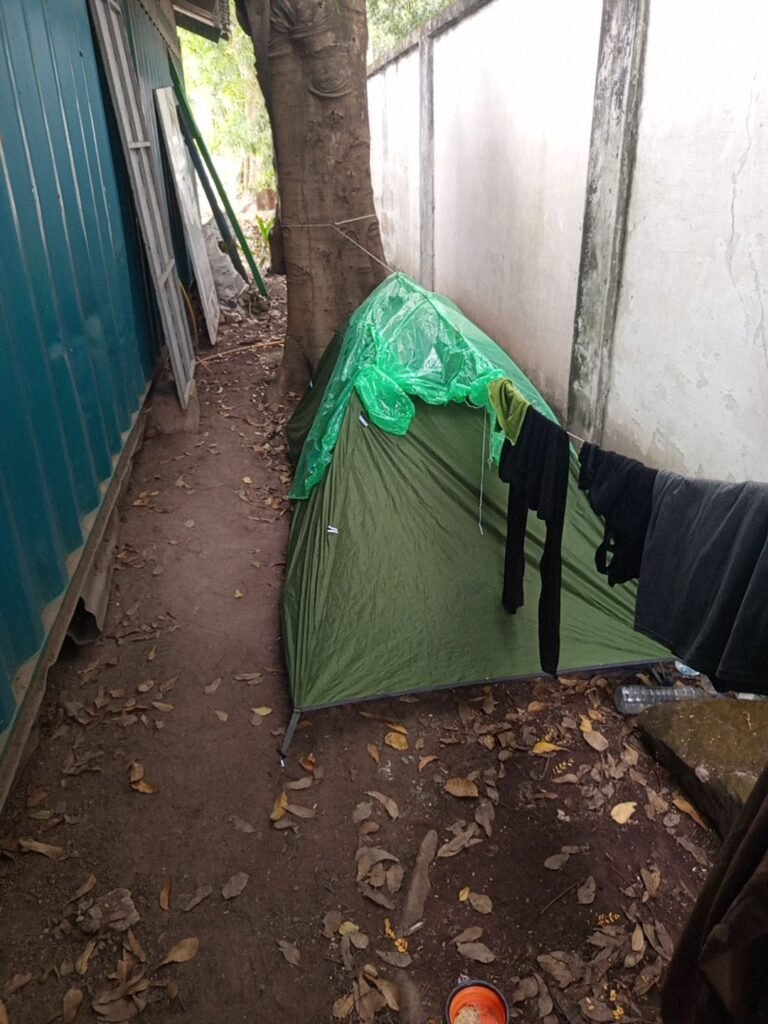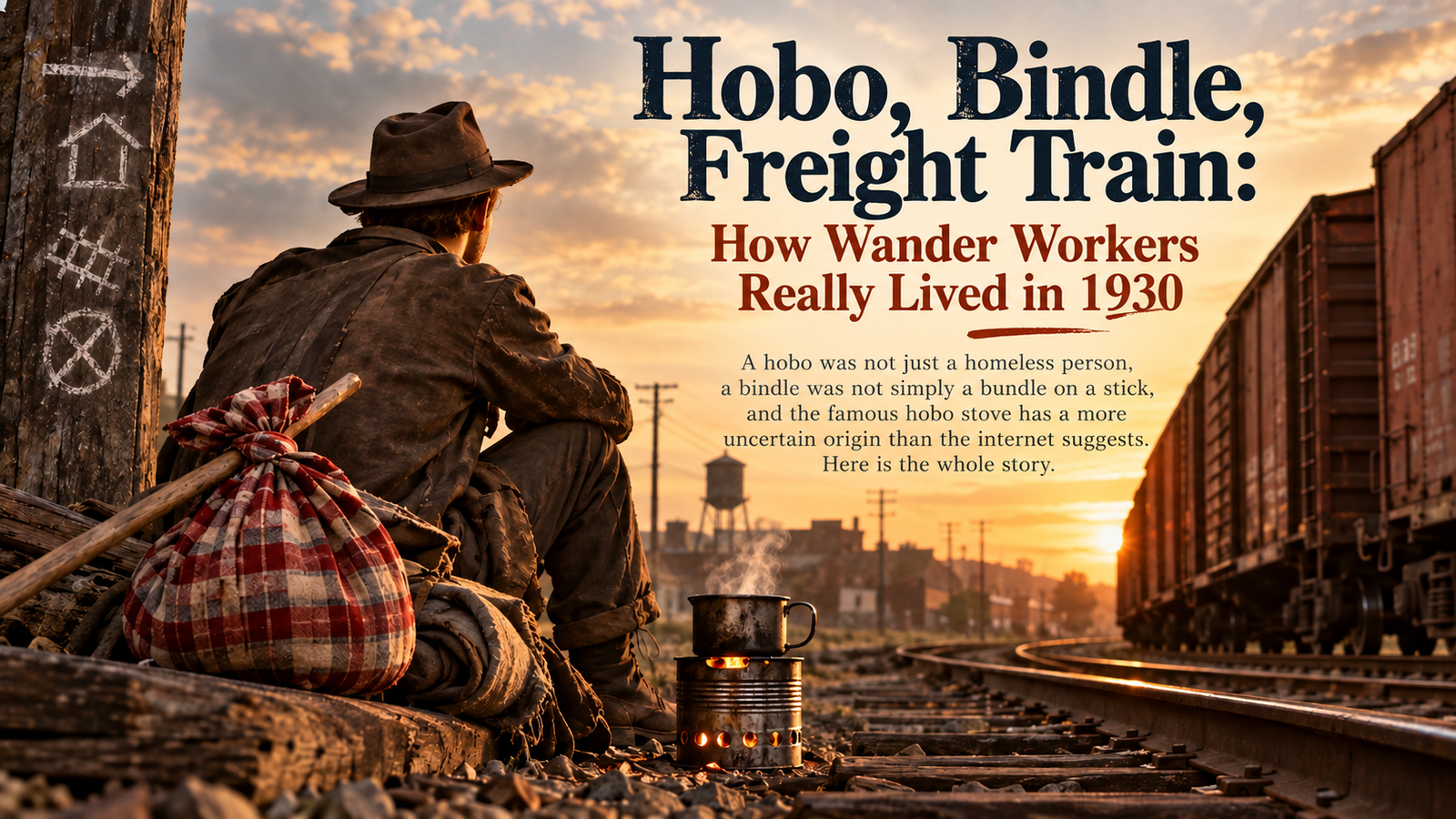
What does a life look like when everything you own fits into a single bundle — and you still have to set off again every morning?
During the years of the Great Depression, hundreds of thousands of people in the United States moved from place to place in search of work. Some walked on foot, others rode the freight trains. They slept in makeshift camps, cooked over fires, and looked for work on farms, construction sites, in factories, or wherever someone happened to need laborers.
They were called hobos.
The famous image of the man with a hat, a bindle, and a stick is still known today. But behind this image lies a far more complicated story — about poverty, mobility, work, railroads, community, and people who were on the road for very different reasons.
Briefly explained
A hobo was historically a mobile worker who moved from place to place and looked for casual, seasonal, or short-term work along the way.
Not every hobo rode a freight train. Not every hobo owned a classic bindle. And not every hobo was homeless.
Rather, the term described a particular form of mobile life — often under economic pressure.
Imagine a morning in the year 1930
It is early.
The night was cold. Your sleeping place was not a bed, but a blanket on the ground of a makeshift camp. Maybe you slept near a train station. Maybe behind a town. Maybe in a so-called hobo jungle.
Your things lie next to you.
Not much.
A blanket. A few pieces of clothing. Some dishes. Maybe a knife. Maybe a can or a pot. A piece of soap. A few personal items.
Then you have to move on.
Because where you found work yesterday, there may be none today.
What was a hobo really?
The word hobo is often equated today with a homeless person. Historically, that is too simple.
Hobos were above all people who were on the move and looking for work. Many lived in extreme poverty, but their mobility had a concrete purpose: they wanted to get to where there was work.
The difference between hobo, tramp, and bum was sometimes explained in contemporary descriptions like this:
Hobo
Someone who was on the move and generally looking for work.
Tramp
A traveler without a fixed place of residence, for whom work was not necessarily the central goal.
Bum
A term for someone who did not work or was not looking for work.
But:
These terms were not perfect scientific categories. Reality was considerably messier.
Why did the railroad play such a big role?
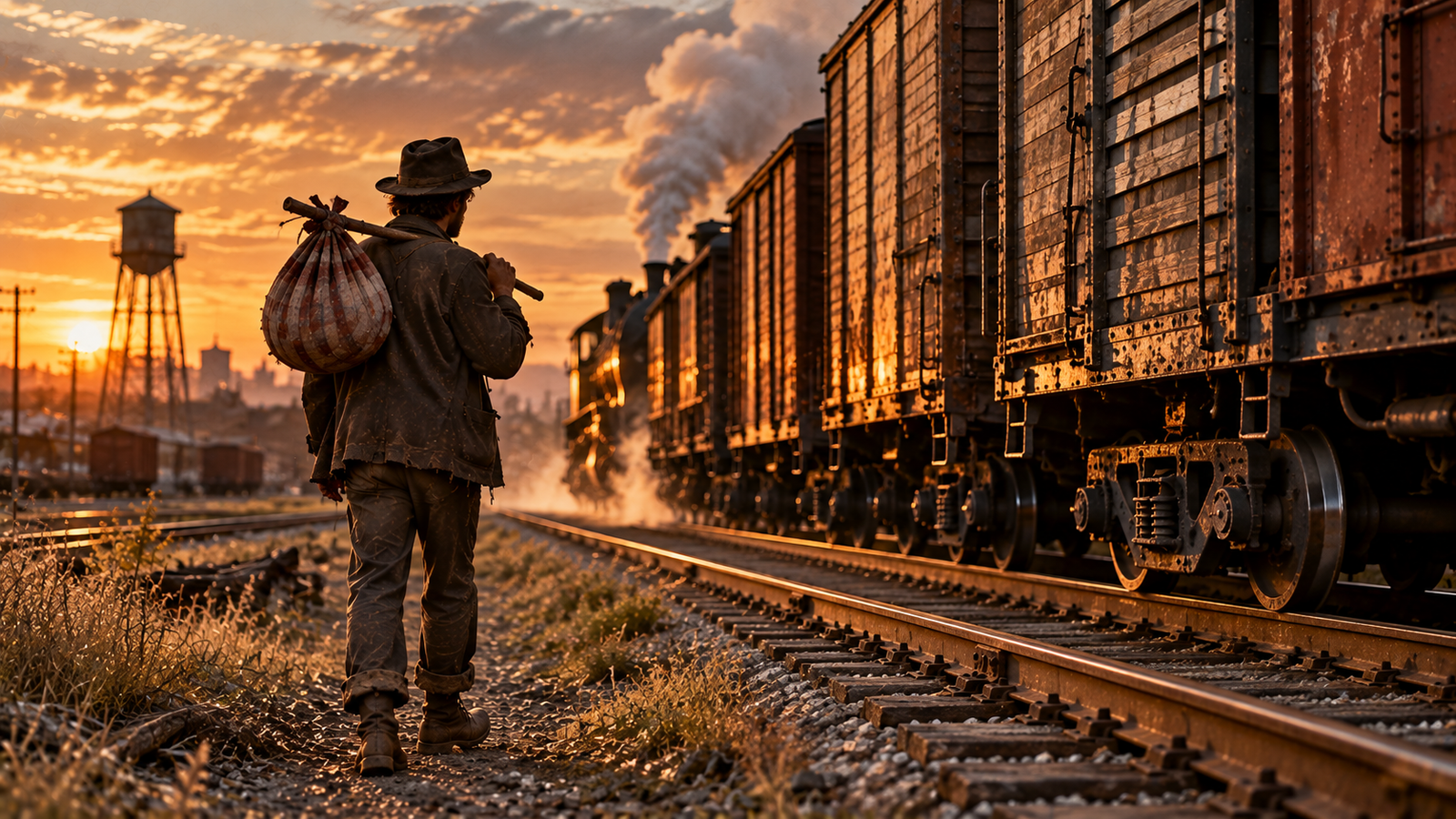
In the early 20th century, the American railroad connected enormous distances.
For a person without money, a train could mean the difference between a place he could never reach and a possible job.
That is why freight trains became an important part of hobo history.
But riding them was by no means without danger.
People could be discovered, driven off, or arrested by railroad workers. Riding between the cars, on footboards, or on other parts of a train could also be life-threatening.
The image of the hobo sitting comfortably in a freight car and traveling across America romanticizes a reality that was often shaped by hunger, uncertainty, cold, and the danger of accidents.
“Catching out” — onto the moving train
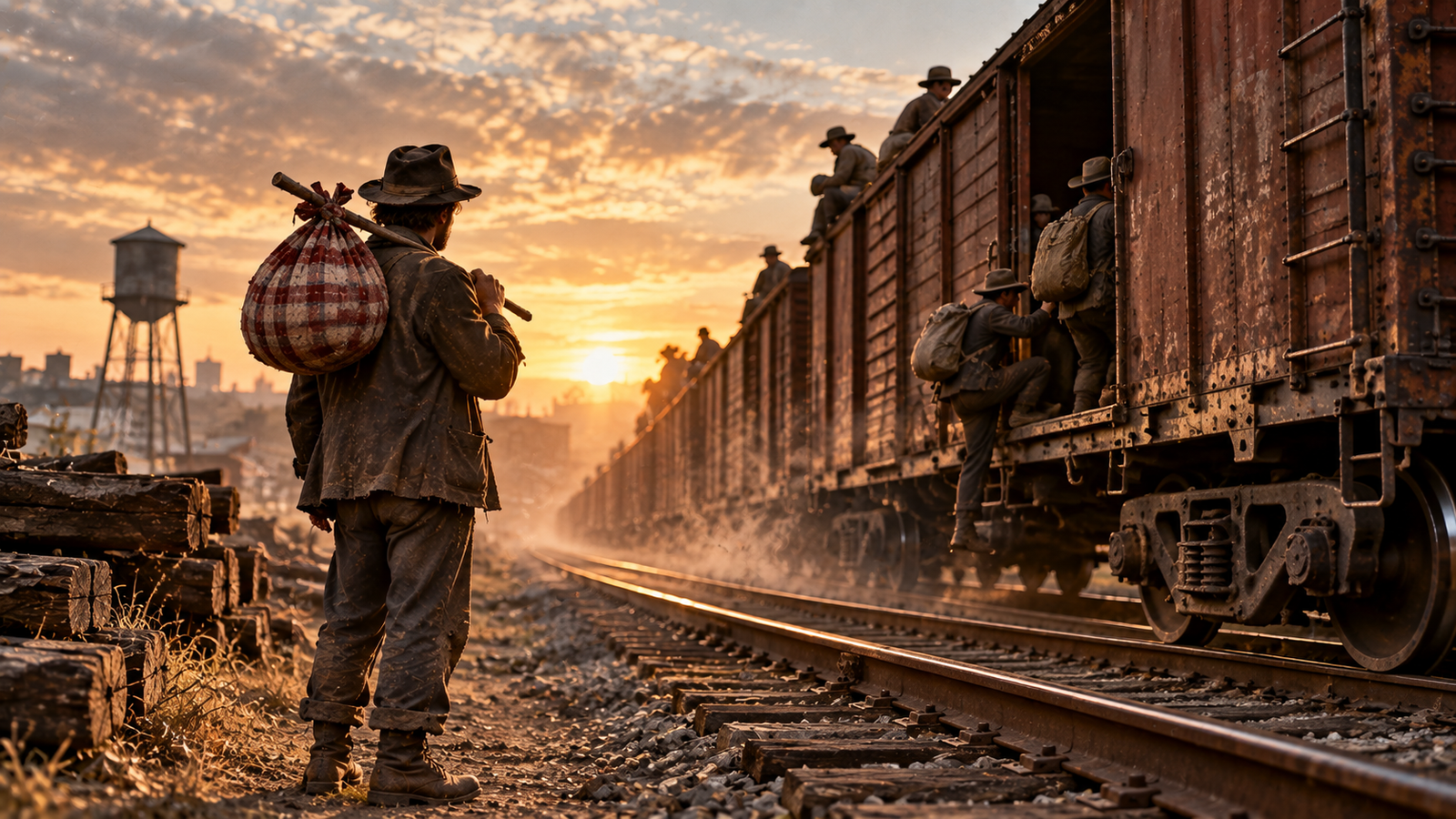
One expression associated with hobo culture is “catching out.”
This meant jumping onto or secretly riding a freight train.
It required experience and timing. At the same time, it was risky.
A wrong step could cause serious injuries. In addition, people who rode without permission were pursued by railroad personnel.
The railroad was therefore at once means of transport, hope, and danger.
The bindle — the famous bundle
Hardly any object is as closely associated with the hobo as the bindle.
It meant a bundle of personal belongings that could be transported easily.
In the well-known depiction, a cloth hangs from a stick. Inside are the traveler’s few belongings.
This image did exist — but it should not be understood as the universal standard equipment of every hobo.
People also used sacks, bags, backpacks, bedrolls, or other makeshift containers.
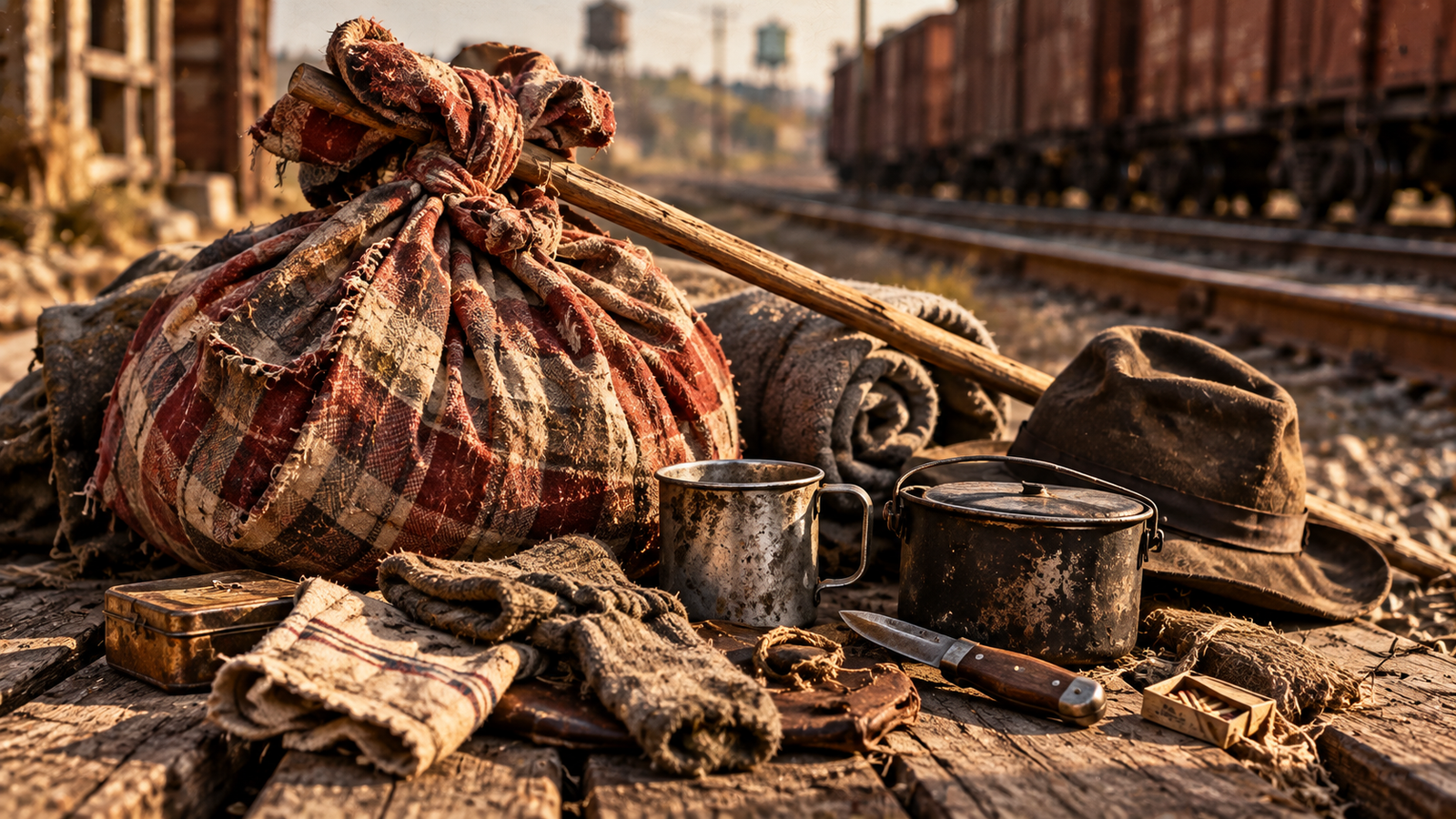
What could have been inside?
A blanket or clothing, something to eat, a cup or pot, personal items, maybe a knife, matches, soap, or a few tools.
However, there was no official hobo packing list.
Why was a blanket so important?
A blanket was more than just something to sleep on.
It could serve as bedding, as extra clothing, as protection against wind, or as part of a makeshift sleeping place.
When you own only a few things, every object has to serve multiple purposes.
That was precisely a form of involuntary minimalism.
Where did hobos sleep?
Not in a single typical “hobo bed.”
People slept wherever it was possible.
In barns. In abandoned buildings. Under bridges. Near railroad facilities. On farms. In wooded areas. In camps outside towns.
The so-called hobo jungles became especially well known.
The hobo jungle — the village without houses
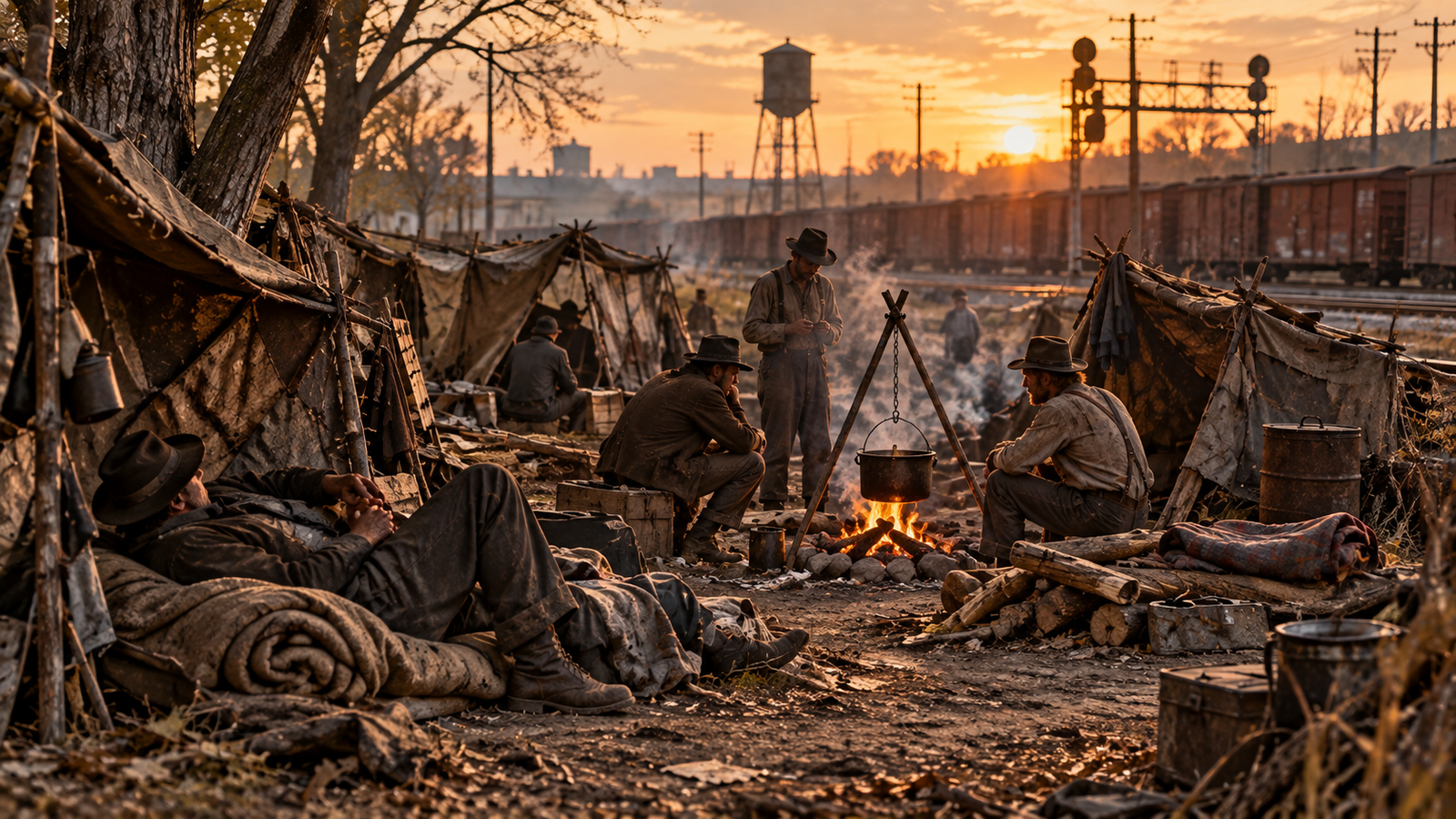
A hobo jungle was an informal gathering of people who were on the move.
Such camps could arise near railroad facilities or on the edge of towns.
There were no official streets and no house numbers.
Nevertheless, remarkably stable social structures could develop there.
People knew where to find water. They knew where there might be food. They exchanged information about work opportunities.
And they knew who was new.
Cooking without a kitchen
Anyone without a fixed place to live also has no kitchen.
That meant: cooking was done outdoors.
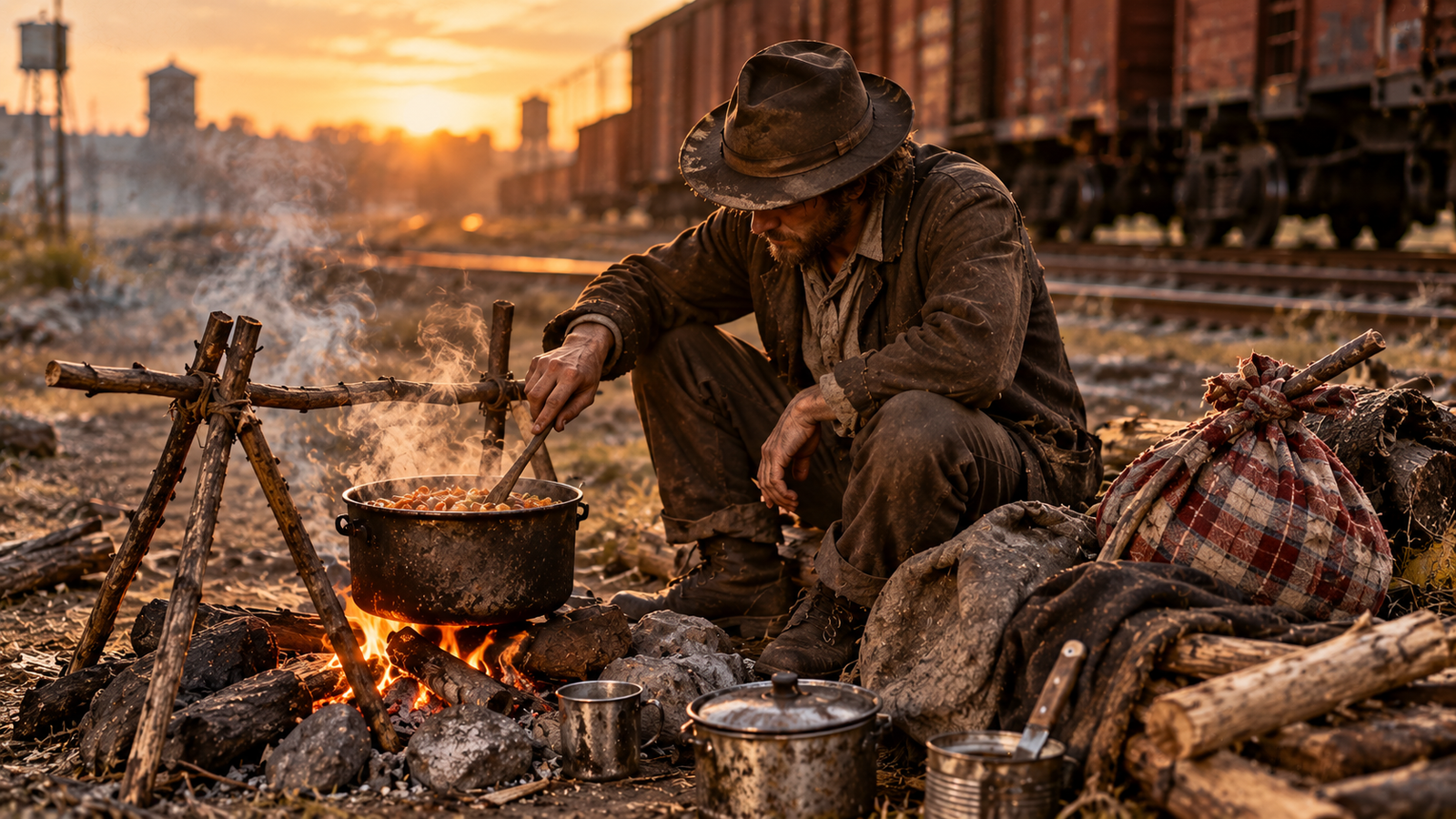
A fire could be made from scraps of wood. Pots, cans, or other suitable metal containers served as cooking vessels.
The kitchen was therefore no bigger than the fire itself.
Mulligan stew — food made from almost anything
The term Mulligan stew refers to a kind of improvised stew cooked with whatever ingredients were available.
Vegetables, potatoes, meat scraps, bread, beans, or other foods could end up in it.
The decisive point was not a fixed recipe.
It was about making something edible out of very little.
The principle: What is left over today can be a meal tomorrow.
Did the famous “hobo stove” exist?
Here it is worth taking a closer look.
Today the term hobo stove is used for small cookers made, for example, from tin cans.
Historically, however, caution is appropriate: from this one cannot automatically conclude that every hobo around 1930 owned a standardized “hobo stove.”
The basic principle of improvised cooking over a small fire is far more plausible and fits the living reality of the time.
How did hobos get food?
In different ways.
Some worked in exchange for shelter or meals. Others received food from private individuals, aid organizations, churches, or soup kitchens.
In the countryside, seasonal work could provide access to food.
And of course, people also traded, gathered, and improvised.
Not every meal was guaranteed.
The other side of the romantic image
Today the life of a hobo sometimes seems almost romantic: freedom, railroads, campfires, wide landscapes, and a life without possessions.
For many people, however, this freedom was not a conscious choice.
The Great Depression had brought millions of people into a situation in which a normal life with a steady job and secure income was no longer a given.
1930: America in crisis
After the stock market crash of 1929, the economic crisis worsened.
Jobs disappeared. Businesses closed. Wages fell.
In 1932, roughly one in four American workers was unemployed.
People moved to where they suspected there was work.
The young hobos
Not only older workers were on the move.
Teenagers and young adults also left their hometowns.
Some wanted to support their families. Others were looking for work. Still others had fled difficult family circumstances.
Especially among young people, economic hardship, a desire for adventure, family problems, and the wish for independence became mixed together.
The women who disappeared on the road
The classic image of the hobo almost always shows a man.
A hat. A coat. A bindle. A freight train.
But this image tells only part of the story.
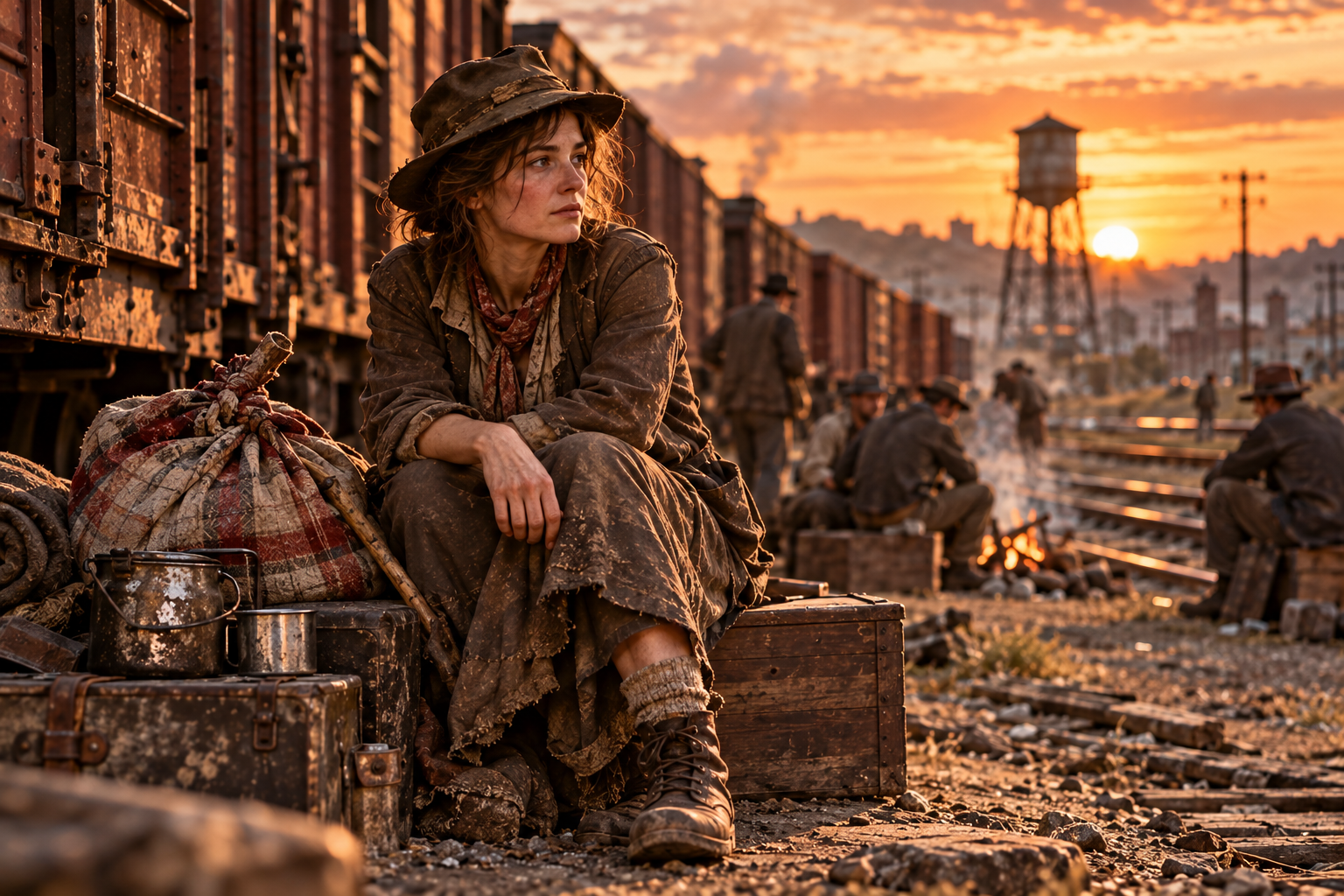
Women were on the move too.
In historical depictions, however, they are significantly less visible. Contemporary observers often regarded wandering in search of work as a predominantly male phenomenon. Later historical research shows that this notion falls short.
In a U.S. survey on transients on August 15, 1934, for example, 4,395 single female transients were recorded. In addition, there were women who were traveling together with families.
This number does not mean that all women who were on the move at that time were recorded. But it clearly shows: women were part of the history of the mobile poor and migrant workers.
Why do we know so little about them?
One reason lies in the assumptions of the time itself.
If an observer expected to see a hobo as a man, women were easily overlooked or not perceived as part of the same group at all.
Historical research also indicates that some women on the road wore clothing that could give them more freedom of movement or protection. As a result, they could become even more invisible in reports and memories.
This does not mean that every woman on the road presented as a man. But the historical notion of the exclusively male hobo is too simple.
For women, being on the road meant additional risks
Women were exposed to the same dangers as other people on the road: hunger, cold, illness, violence, arrest, and unsafe sleeping places.
In addition, there were gender-specific dangers and a particular dependence on other people.
A safe sleeping place could have a completely different meaning for a woman traveling alone than for a man traveling alone.
The possibility of finding work was not the same either. Women faced different restrictions and expectations in the labor market of that time.
Women with children
Not all people on the road were alone.
The great mobility of the Depression era also affected families.
The transient survey of 1934 therefore distinguished not only between single men and women but also recorded people who were traveling as families.
For a family, migration meant a particularly difficult form of mobility: food, sleeping places, and work had to be found not just for one person.
“Boxcar Bertha” — between history and myth
A famous example from hobo folklore is “Boxcar Bertha.”
The name became known above all through Ben Reitman’s 1937 book Sister of the Road.
The story was later heavily romanticized and popularized. It should therefore not simply be read as the fully verified autobiography of a single woman.
Nevertheless, it shows something important: the idea of the wandering woman was definitely part of American hobo culture and was already being passed on at the time.
Young women on the road
Contemporary studies of young people are particularly interesting.
The social researcher Thomas Minehan collected 1,465 life stories of young tramps in a study from the 1930s; among them were 88 girls.
That too is not a statistic about all young women on the road. But it shows that female adolescents and young women in this world were by no means only a theoretical exception.
A woman’s bindle
For women, too, the same basic problem applied:
Everything you own must remain portable.
Clothing, blanket, personal items, maybe a cooking vessel or small work items — more could hardly be carried on long journeys.
The bindle was therefore less a “man’s object” than a symbol of a way of life in which possessions could become a burden.
A different kind of freedom
For some people, life on the road could also mean a form of escape: away from a difficult family, a bad job, or a place where they saw no future.
But freedom and uncertainty lay close together.
And Black hobos?
The history of Black migrant workers is also part of the history of mobility during the Depression.
But here too, caution is necessary with the classic hobo image.
Racism and the racially segregated society of the United States influenced which jobs were reachable, where people could sleep, and how they were treated.
The experience of a Black migrant worker could therefore differ considerably from that of a white migrant worker.
The famous image of the white man with a bindle is thus not only incomplete — it also says something about which people remained especially visible in later memory.
The mysterious signs of the hobos
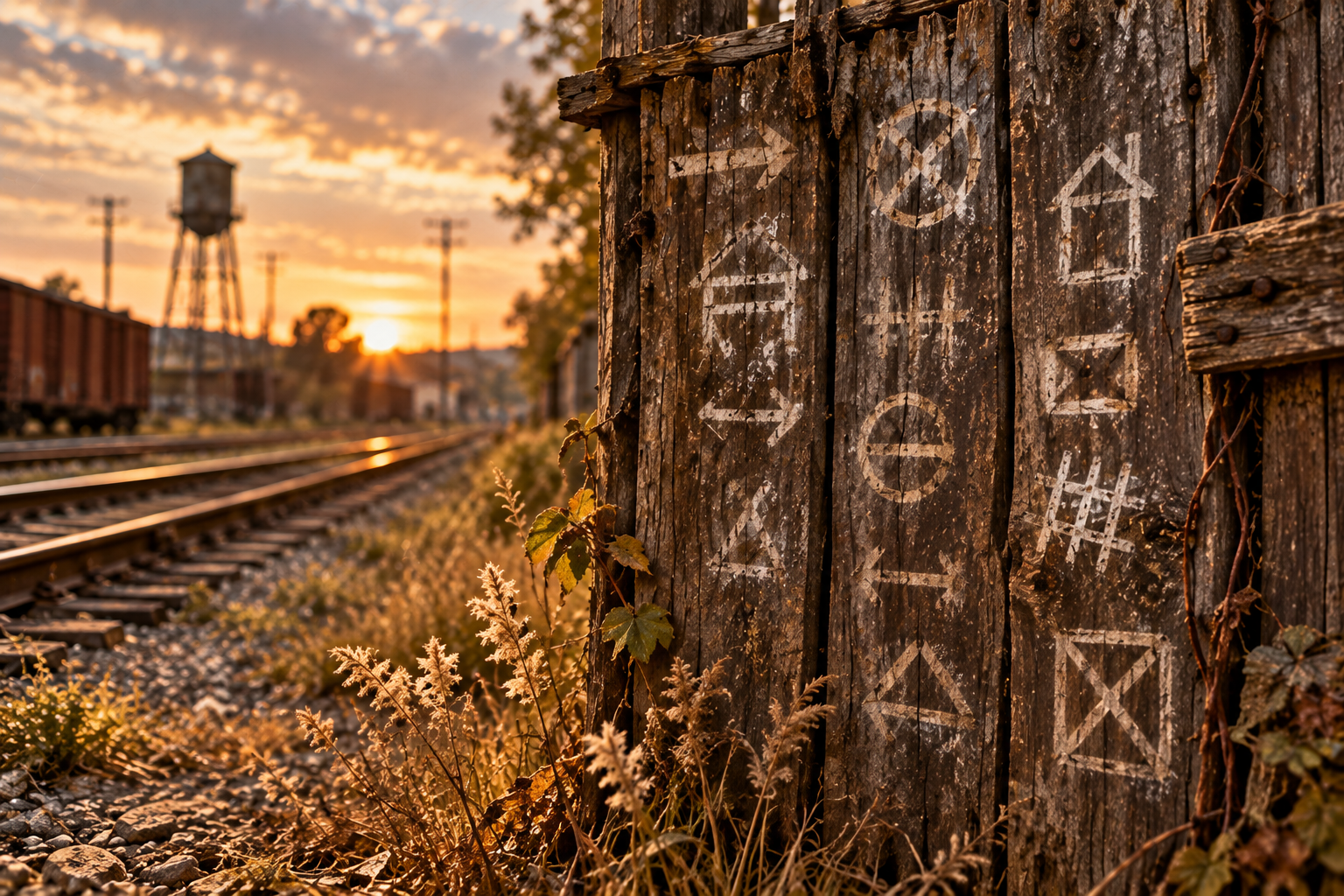
One of the most fascinating stories surrounding hobos are the so-called hobo signs.
These were signs that could give hints to other travelers at certain places.
They could convey information about water, food, a friendly family, or dangers, for example.
But caution: today, a great many lists of supposedly fixed hobo symbols circulate on the internet.
Not every one of these signs can be clearly verified historically. There was no single, everywhere-identical official hobo secret language.
The hobo network without the internet
Imagine you arrive in a strange city.
You have no smartphone.
No Google Maps.
No job board.
No Facebook group.
And yet you have to find out where there is work.
Information was therefore passed on in person.
Someone who had just come from a farm could tell that workers were needed there. Someone who came from another city might know about a factory or a construction site.
Hobo jungles and other meeting places thus became social information networks.
How much did a hobo own?
The most honest answer is:
There was no fixed set of equipment.
But the logic was simple.
Everything you own, you have to be able to carry.
Very important
Blanket, clothing, shoes, something to sleep on.
For eating
Cup, pot, can, knife, or other simple containers.
For work
Depending on the task, simple tools or work clothing.
Personal
Letters, photos, small keepsakes, or other things with emotional value.
A possible day in the life of a hobo
Of course, there was no uniform daily routine.
But a day could look roughly like this:
The language of the hobos
Hobo culture also developed its own mixture of slang and terms.
Bindle
Bundle of personal belongings.
Hobo jungle
Informal camp of travelers and job seekers.
Catching out
Secretly riding a freight train.
Bull
Term for railroad personnel who pursued or drove off hobos.
Poke
A term for one’s personal bundle or luggage.
Mulligan stew
Improvised stew made from available ingredients.
Were there rules among hobos?
In many hobo communities, informal rules developed.
These included mutual consideration, the handling of shared resources, and certain expectations within a camp.
However, these rules were not identical everywhere.
A hobo jungle was not an official organization with a uniform set of bylaws.
Hobo or modern nomad?
Today we use words like nomad, digital nomad, or backpacker for people who are on the move voluntarily or at least largely by their own choice.
At first glance, there are similarities.
Few possessions, changing places, sleeping on the road, and constantly new surroundings.
For many hobos, mobility was a consequence of economic hardship — not a lifestyle.
Hobo and backpacker — what is the difference?
A modern backpacker normally has money, a smartphone, a credit card, a passport, and the ability to book accommodation at any time.
A hobo often did not have these safety nets.
A modern backpacker can say:
A hobo might have had to say:
Myth and reality
Every hobo rode freight trains.
Freight trains were important, but hobos also walked or used other means of transport.
Every hobo had a stick with a cloth bundle.
The bindle is historically real, but its famous depiction is highly symbolic.
All hobo signs had a fixed meaning.
There were hobo signs, but no fully uniform universal symbolic language.
Hobos were simply people who did not want to work.
The classic hobo term referred precisely to people who were on the road looking for work.
Why does this story still fascinate us today?
Perhaps it is the mixture of freedom and danger.
A person owns almost nothing and can still set off.
No apartment.
No full wardrobe.
No car.
No digital world.
Only what he can carry.
From today’s perspective, that seems almost romantic.
But precisely here one should be careful.
The reduction to the essentials can be fascinating. The poverty behind it should nevertheless not be romanticized.
What can we learn from it?
Perhaps not that we should all jump onto freight trains with a bindle.
But the story shows something else:
People can become astonishingly flexible when they have to get by with very little.
They develop networks.
They share information.
They find solutions.
They build communities in places that were not actually intended for that.
And sometimes they carry astonishingly little with them — while at the same time carrying an entire life full of memories.
And then there is the bindle again
Perhaps that is why it is the strongest symbol of this story.
Not because every hobo actually traveled in exactly that way.
But because a small bundle makes a big question visible:
How much does a person really need?
And how much of what we own would we truly miss if we could no longer carry it?
A Last Trace
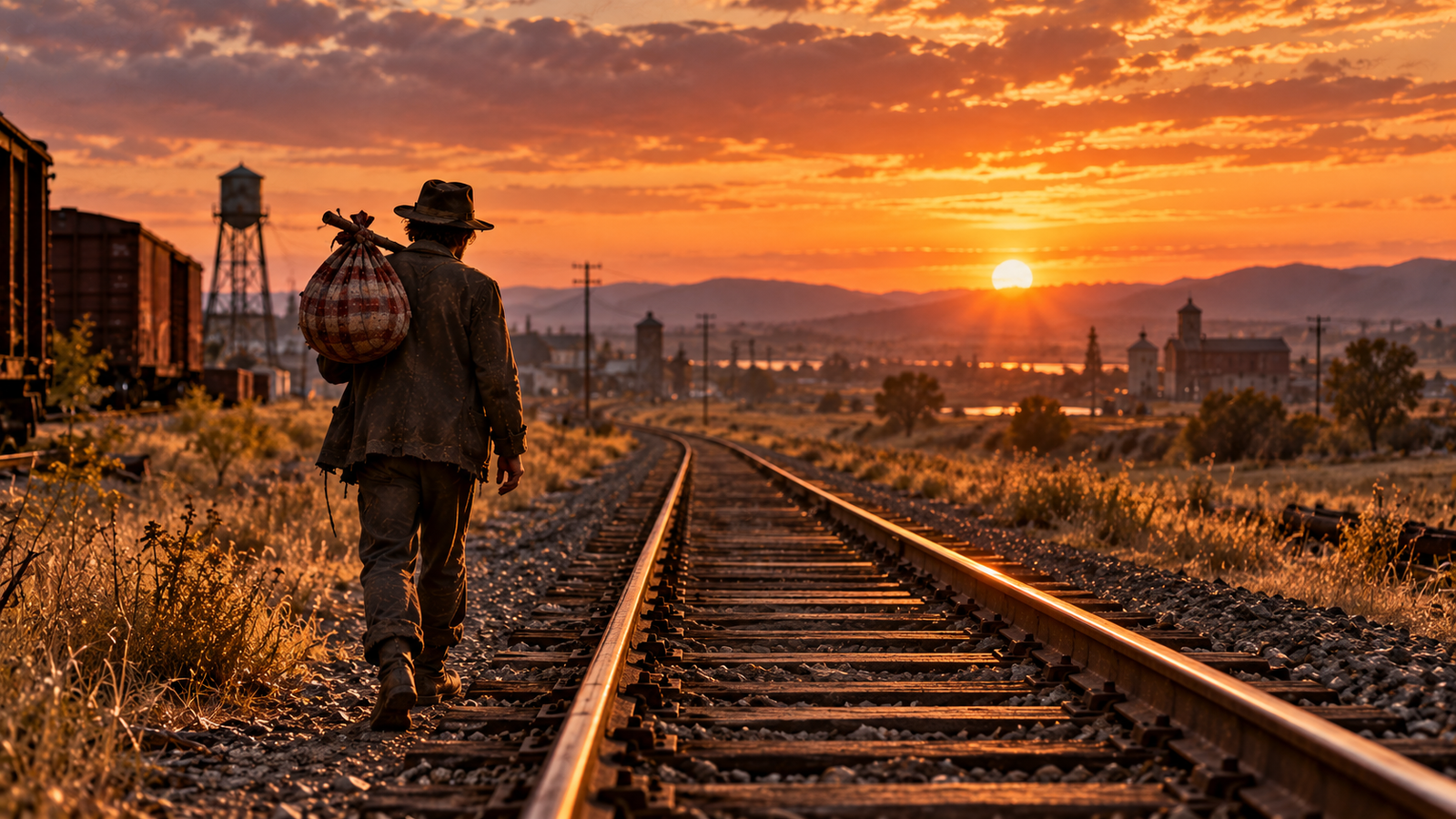
Perhaps somewhere in the America of the 1930s, a person really did walk along a railroad line with just such a bundle.
He might not yet have known where he would sleep that evening.
But he knew that he had to keep going.
Not necessarily because he wanted to see the world.
But because somewhere beyond the next station, work might be waiting.
Frequently asked questions about hobos
What is a hobo?
A hobo was historically a mobile worker who moved from place to place while looking for work. The term is often associated with the time of the Great Depression.
What is a bindle?
A bindle is a bundle of personal belongings that can be easily transported. The famous cloth bundle on a stick is today one of the best-known symbols of hobo culture.
What did hobos carry?
That varied greatly. Clothing, blanket, cooking vessel, personal items, and sometimes tools were among the possible things. There was no uniform set of equipment.
Where did hobos sleep?
Depending on the situation, in hobo jungles, barns, abandoned buildings, under bridges, near railroad facilities, or at other makeshift sleeping places.
What was a hobo jungle?
A hobo jungle was an informal camp where mobile workers and other people without a fixed place of residence gathered.
What did hobos eat?
That depended heavily on what was available. Food could be bought, traded, received, or earned through work. Improvised stews like Mulligan stew are closely associated with hobo culture.
What is the hobo code?
This refers to signs and symbols that could convey information among travelers. However, not all symbol lists circulating on the internet today are historically clearly verified.
Did hobos have a hobo stove?
Improvised cooking places and simple containers were obvious. However, the term “hobo stove” as used today should not be understood to mean that every hobo around 1930 used the same cooker.
Why did hobos ride freight trains?
Freight trains made it possible to cover great distances without a regular ticket. However, this was illegal or unauthorized and could be life-threatening.
Were hobos nomads?
They were mobile, but the term nomad only partially captures the historical situation. For many hobos, movement was above all a strategy for finding work and thus a consequence of economic hardship.
Were there also women among the hobos?
Yes. Women were on the move as well, but they are significantly less visible in later depictions of hobo culture. A U.S. survey from 1934 recorded, for example, 4,395 single female transients.
Sources and further information
National Archives:
Material on the FERA survey on transients from August 15, 1934.
Library of Congress:
Historical materials on the Great Depression, migrant workers, and riding freight trains.
Smithsonian Institution:
Background information on hobo culture, hobo jungles, railroads, and migrant labor during the Depression.
Nels Anderson:
Sociological studies on hobos and the life of migrant workers in the United States.
Thomas Minehan:
Studies on young people and hobo culture during the 1930s.
Note on historical depiction:
The term “hobo” does not describe a completely uniform group. Living conditions, origin, gender, skin color, age, and access to work could significantly change experiences. Many stories about hobos that are widespread today were also later romanticized or simplified.