Between Camel Thorn Tree and Iron Ball
An Afternoon at the Keetmanshoop Museum
About a church that became a cabinet of curiosities, a man who never set foot in his namesake town, and the things I saw there – some of them quite different from what I first thought.
There are places that announce themselves long before you arrive. Even on the B1, hours before the first houses emerge from Namibia’s shimmering south, something shifts: the quiver trees grow denser, the earth turns redder, and at some point a church tower appears on the horizon that looks as if it had been transplanted from a Bavarian village. Welcome to Keetmanshoop – the “capital of the south,” as they like to say here, although barely 30,000 people live there.
If these stories mean something to you
The Oddity Expedition is written slowly — somewhere between dusty roads, long bus rides, forgotten border towns and the quiet moments in between.
If a story stayed with you, you can help keep this journey alive.
☕ Support the journeyI was passing through, had actually only planned a brief stop – and ended up wandering through a small museum housed in an even smaller church for three hours. I photographed whatever seemed strange or beautiful to me, without always reading the labels correctly. Only later, when I looked at the photos in peace and actually deciphered the museum signs, did some assumptions turn into entirely different, often much more interesting stories. It’s exactly this path – from first impression to the real story – that I want to take you on here.
What Does “Keetmanshoop” Actually Mean?
Before any European ever stood here, this place was called ǂNū-ǂgoaes. A museum panel states it precisely: it was the Nama Chief (Captain) Hendrik Tseib, leader of the ǃKharo-ǃoan tribe, who around 1850 discovered the spring that gave this place its name – “spring of the black mud,” named after the iron-rich, dark soil around the water. The Boers who came later simply translated it into Afrikaans: Swartmodder.
It wasn’t until 1866 that things fundamentally changed here. The Rhenish Missionary Society sent missionary Johann Georg Schröder to establish a station for the Christianization of the Nama. The whole endeavor was financed, however, by someone who never set foot in this country: the German merchant and industrialist Johann Keetman. In gratitude for his generous, ongoing support, the station was named after him – “Keetmans Hoop,” roughly “Keetman’s Hope” in Afrikaans.
A man who gave an entire town his name without ever having seen it – I found that strangely moving even on site.
From the small mission station, a proper settlement grew during the German colonial period: with a post office, a fort, and from 1908 onward, a direct railway connection to Lüderitz. This railway line made Keetmanshoop one of the most important transport hubs in the south of present-day Namibia for several decades – more on that below, because its construction history is anything but harmless.
The Church That Became a Museum
The heart of the town – and also of my afternoon – is the old Rhenish Mission church, built in 1895 from local natural stone, with Gothic window arches that look strangely out of place among all the ochre and dust outside. Since 1978, it has been a protected monument. When the church was built, an old camel thorn tree already stood on this spot. They didn’t cut it down – they simply built around it. Its trunk and branches were later made into the pulpit. A tree as a preaching chair, right in the middle of the house of God.
Inside, everything is strikingly unadorned: a simple wooden pulpit, a few plain rows of benches left and right. Today, the church houses the small town museum – and right outside, the model of a traditional Nama dwelling.
What I Saw – and Misunderstood at First
And then there are the things I initially got wrong. I’ll show them to you in the order I experienced them – first the impression, then the resolution. This was the most exciting part for me personally.
The Elephant Skull – Not a Question of Origin, but a Warning
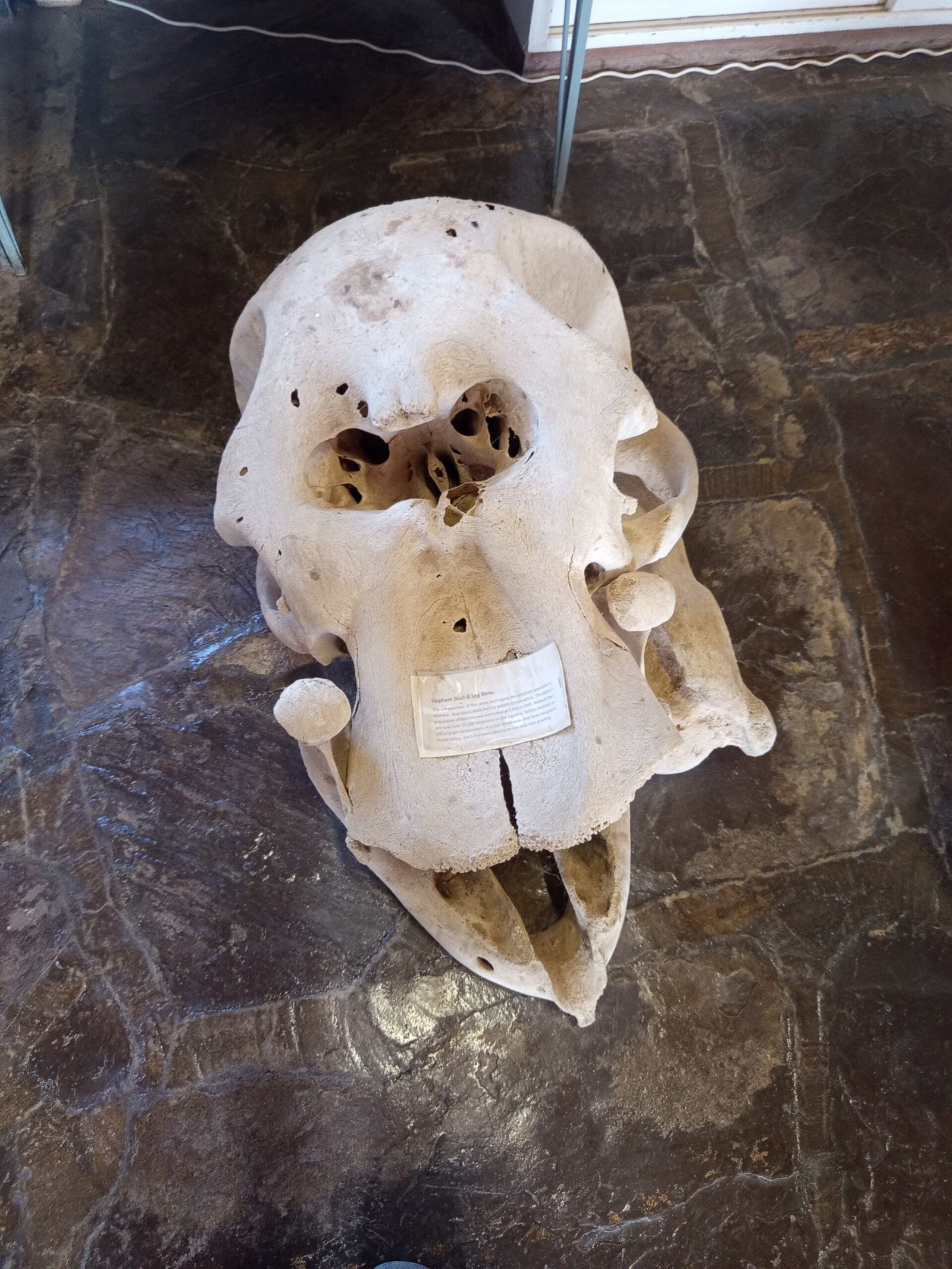
Right in the first room: an imposing, yellowed elephant skull that stares at you as soon as you open the door. I first thought it must be a riddle – elephants today live mainly in northern Namibia, not in this dry corner of the south. But the label didn’t tell an origin story at all, but rather a conservation message: The introduction of firearms once dramatically decimated Namibia’s elephant population. In 1995, only about 7,500 animals were counted in the country; today there are over 20,000 – one of the few genuine success stories of species conservation here. The panel made clear, however, where the real danger lies today: with the rhino, which remains a target of poaching, and that every Namibian can help in the fight against poaching.
Not a Dirndl – A Nama Dress with a Surprising Kinship
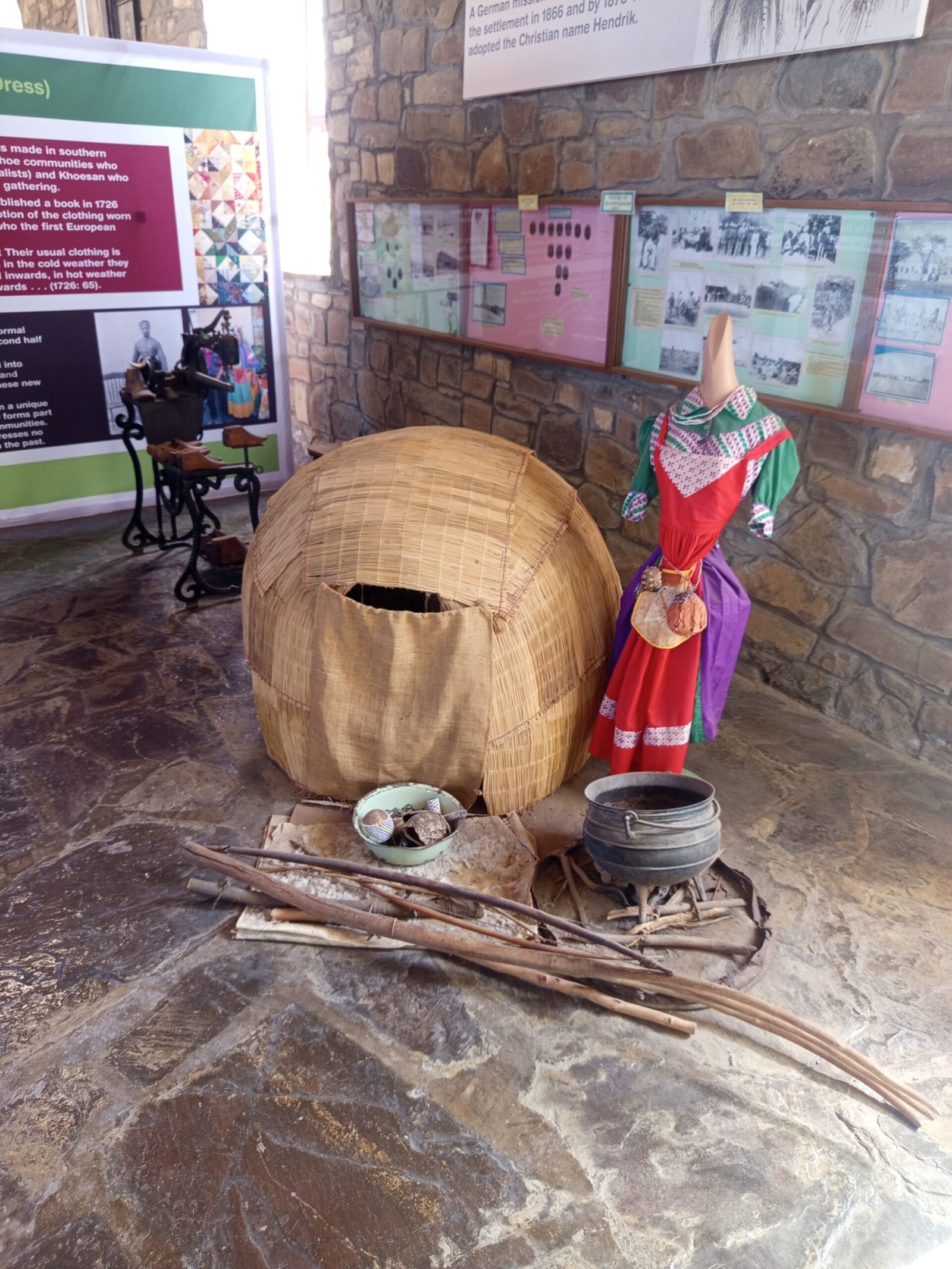
I first thought I was seeing a Bavarian Dirndl, displayed right next to the model of a traditional Nama dwelling – a strange cultural mix, I thought. In fact, it is a traditional Nama dress, not a European import. And yet, my first impression wasn’t entirely wrong: the information panel next to it explains that the traditional clothing of the Nama and Khoisan communities in southern Africa was already described in a book in 1726 – and that today’s festive Nama dress, with its colorful fabrics, wide skirts, and geometric patterns, developed strongly under the influence of the clothing that German missionary families brought with them from the 19th century onward. The Victorian silhouettes of the missionary women – tight bodice, wide skirt, often with an apron – and the traditional Dirndl fashion from the same century share a common origin in the rural European fashion of that era. No wonder my eye immediately saw “Dirndl”: the family resemblance is real, just the address was wrong.
The “Turtle Shells” – And I Was Actually Right
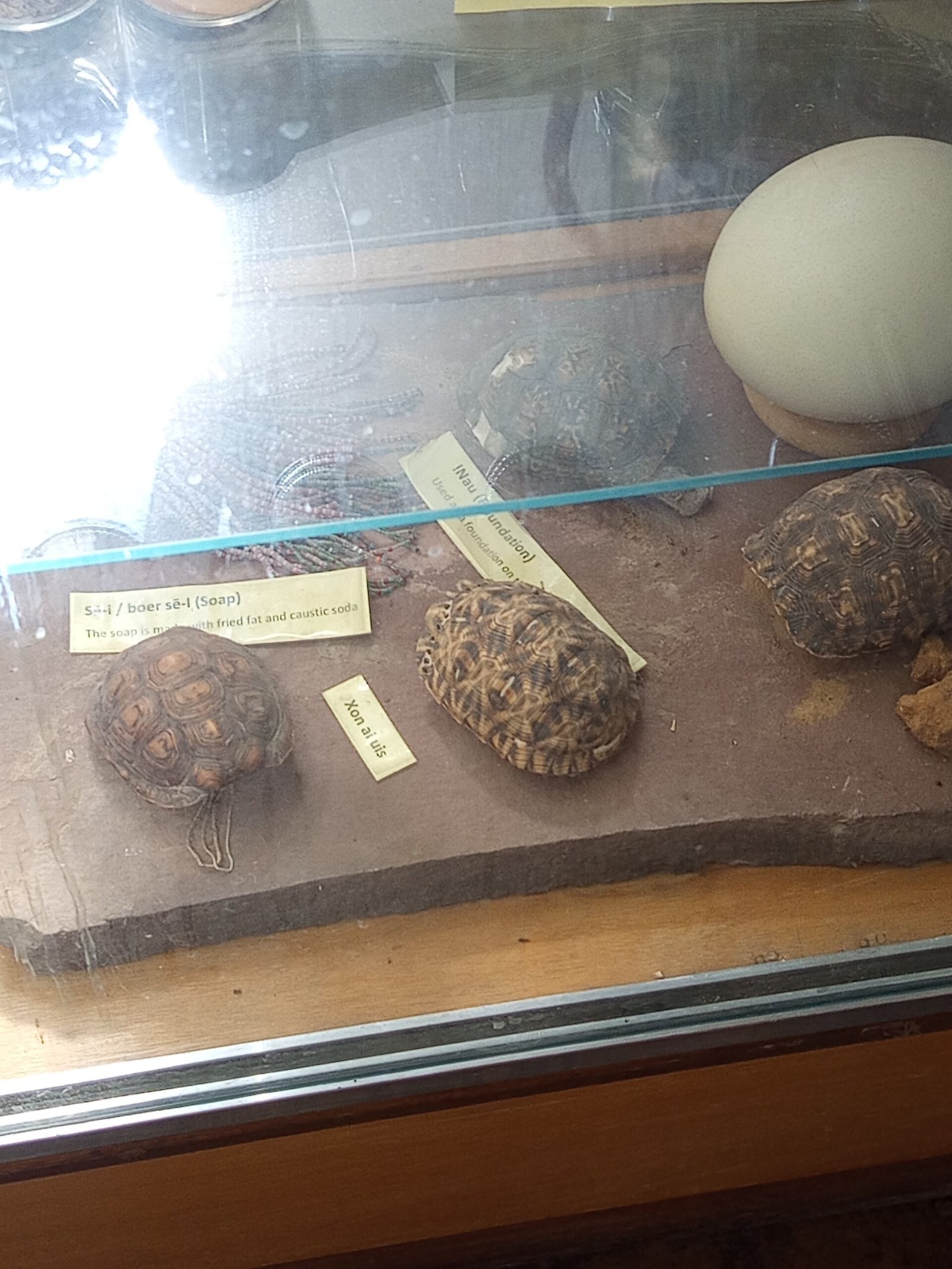
Here, my first glance was actually right: they are real turtle shells, not molded soap. They served as natural containers or molds for homemade soap, traditionally boiled from rendered animal fat and caustic soda (lye) – a simple, robust household technique passed down through generations in many rural communities in southern Africa. Right next to them, by the way, was an ostrich egg for size comparison.
The Wagons Under the Roof
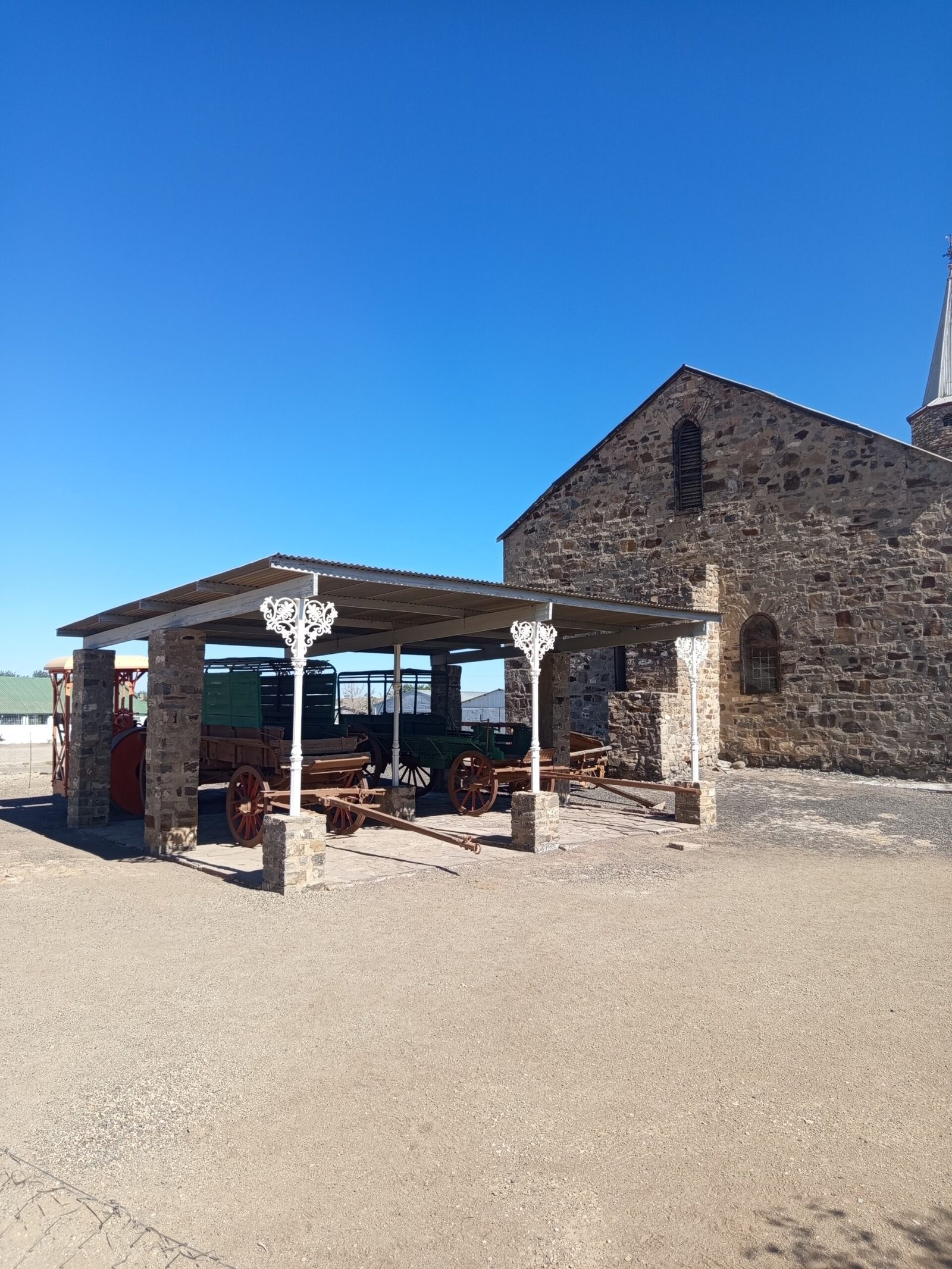
Outside, under a simple roof right next to the church, stood several old wooden wagons with tall spoked wheels – probably horse or ox wagons from a time when there were neither railways nor paved roads. Among them: ornately decorated wrought iron lamp posts and, somewhat off to the side, an old machine with a red-painted drum that looked like an early engine or pump. I imagined what it must have felt like: bumping for days through this shimmering heat, with nothing but horizon in every direction.
A Sign Between Two Empires – And a Quieter Story Beside It
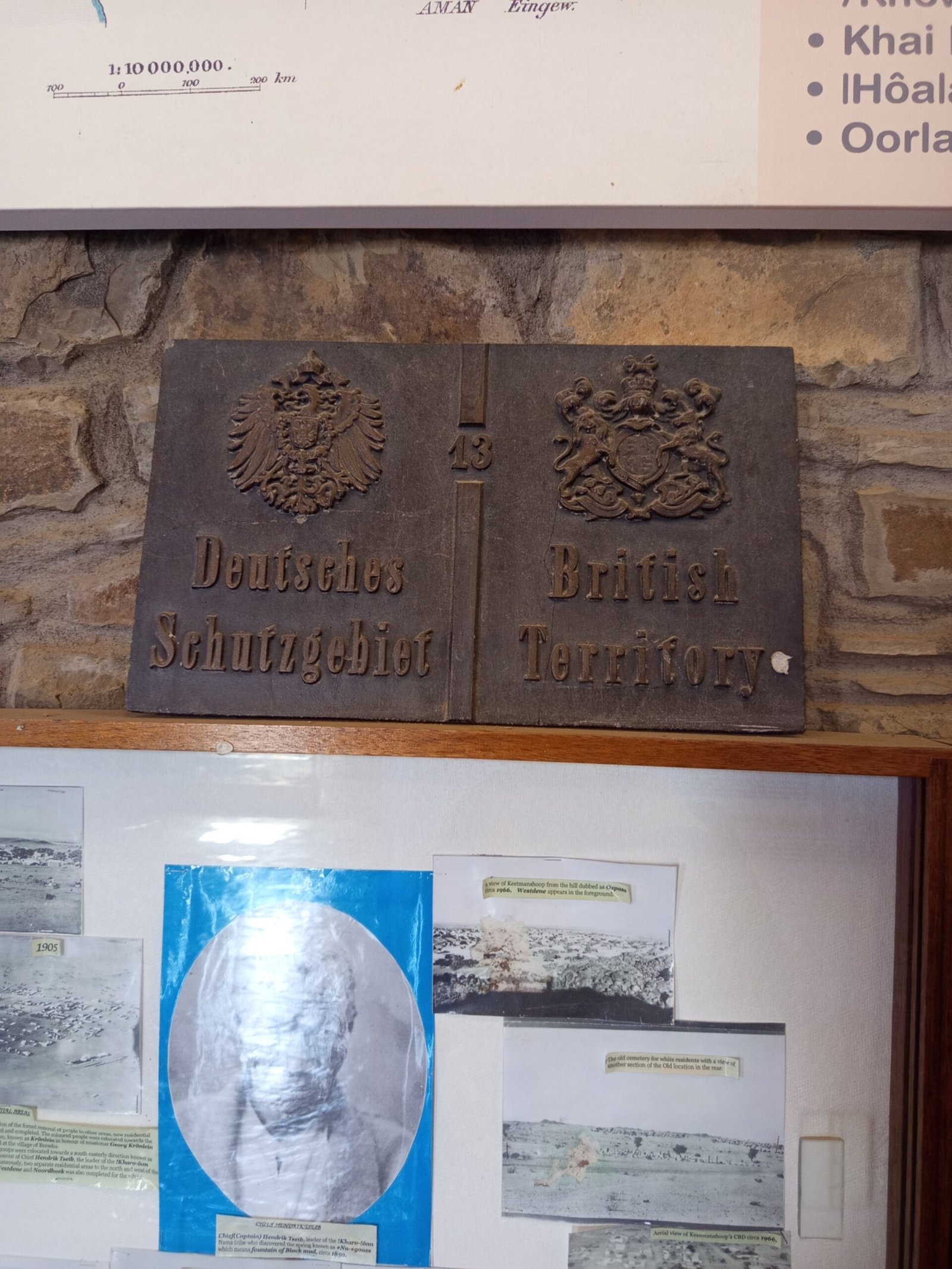
One of the objects that kept me standing in front of the display case the longest: a divided sign, on the left the German imperial eagle above “German Protectorate,” on the right the British royal coat of arms above “British Territory,” with a small “13” in the middle – presumably a numbered border marker along the colonial border of the time. The border between what was then German South-West Africa and the adjacent British territories goes back to the Heligoland-Zanzibar Treaty of 1890, negotiated between the German Empire and Great Britain, far away from the people living on both sides of that line.
Right next to it hung a second, more inconspicuous panel that occupied me almost even more: it describes forced relocations in Keetmanshoop – the “colored” population was resettled to a new residential area called Krönlein, named after missionary Georg Krönlein, while other groups moved to separate areas north and west of the town, now known as Westdene and Noordhoek. This story is more recent than the colonial period in the narrower sense – it belongs to the time of South African administration and apartheid – and shows how long border-drawing and separation run through the history of this one place: first between empires on paper, later within the same town.
The Silver Trophy – And a Ball That Weighs Heavier Than It Looks
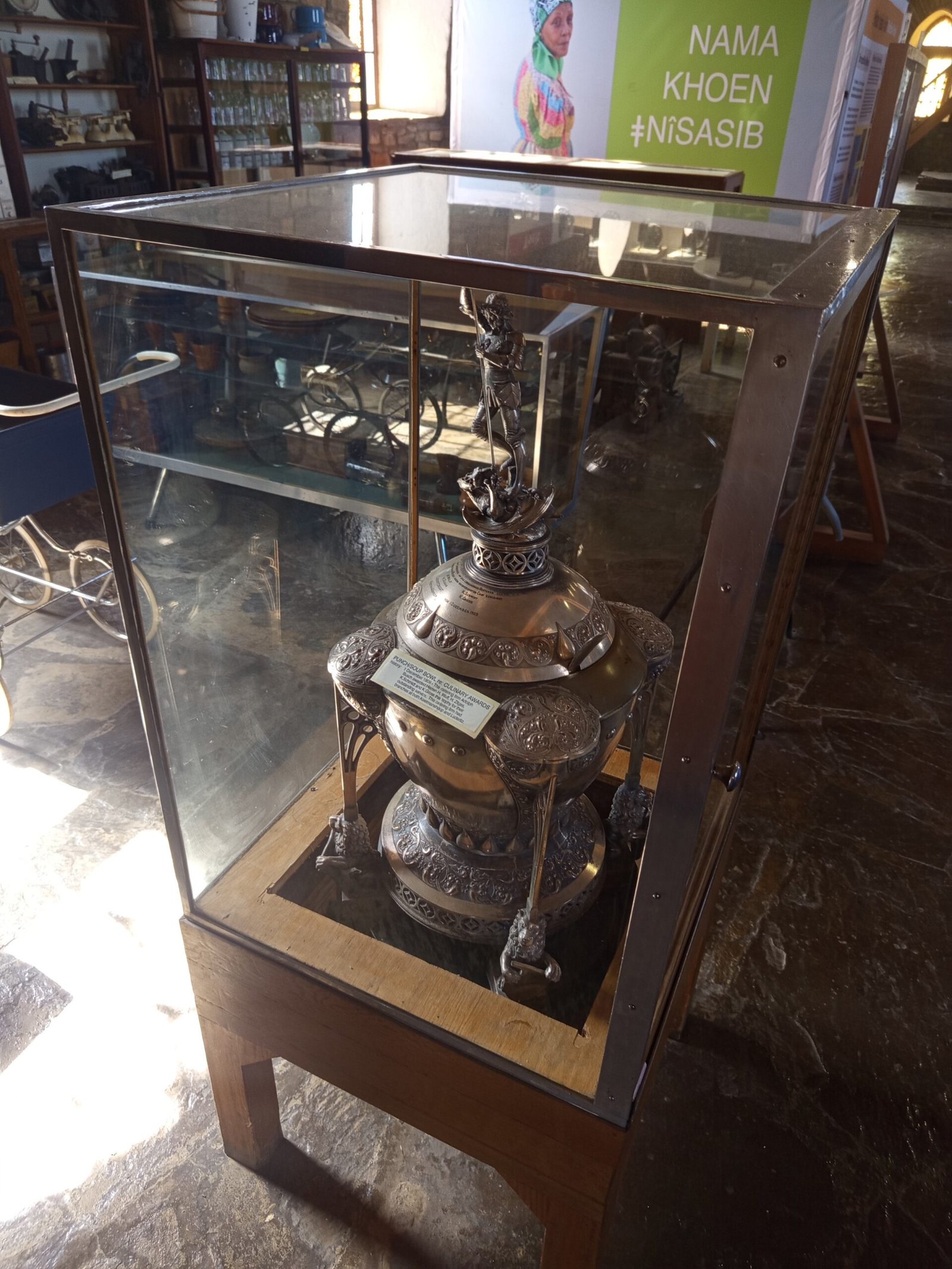
I had first assumed this ornate silver pot was simply aristocratic table silver. But the small label in the display case says something different: “Punch/Soup Bowl” – a trophy awarded for outstanding culinary achievements, apparently given to town residents in the early 20th century. Not an object from an aristocratic household, then, but a competition prize – probably from a local cooking or baking competition, as existed in many settler communities to organize a bit of social life and recognition among themselves.
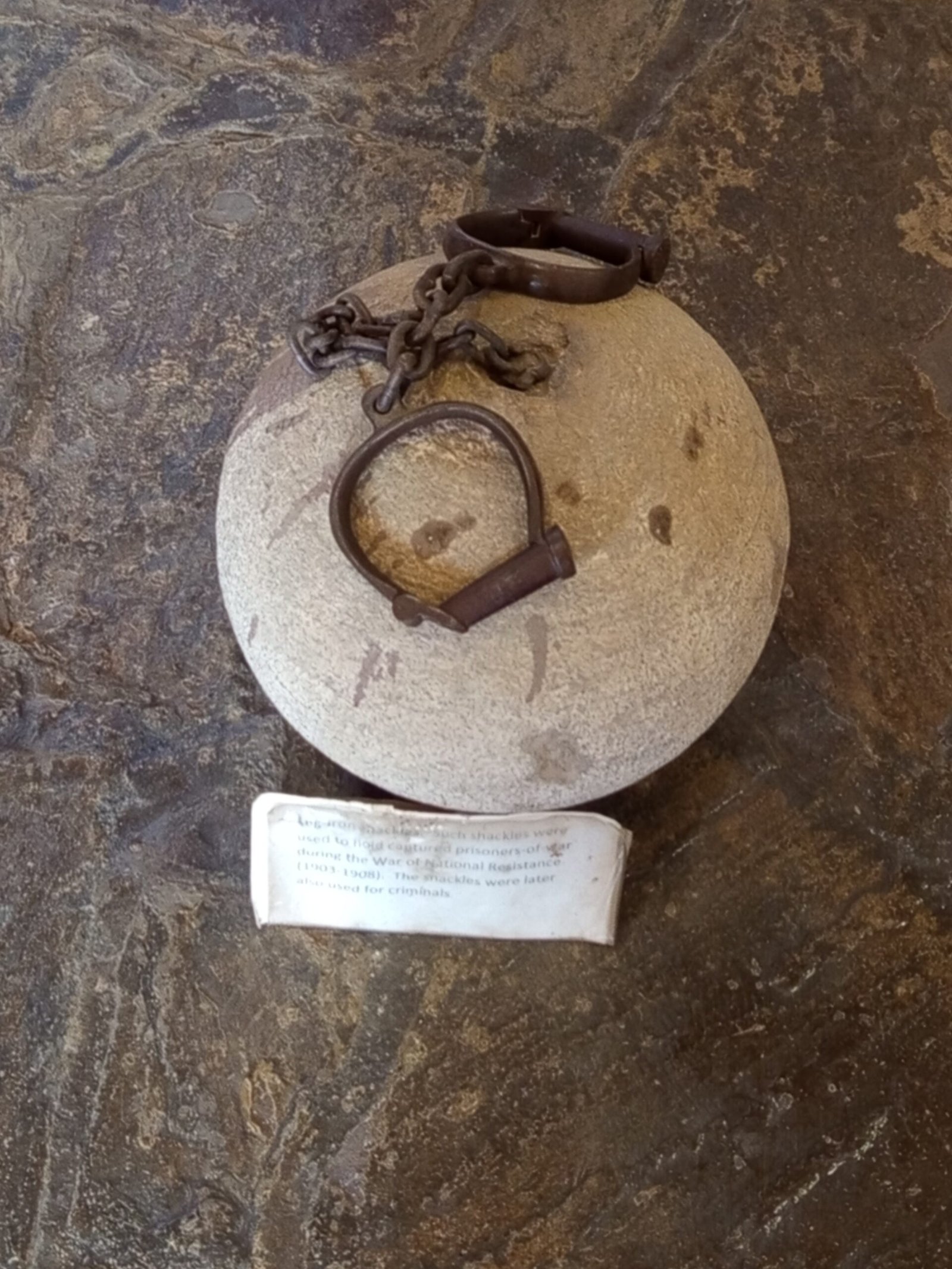
Just a few steps further: a heavy, light-colored ball with attached leg shackles. Unlike the other objects, there was no room for interpretation here – the label says it directly: these shackles were used to hold prisoners of war during the “War of National Resistance” from 1903 to 1908 – that war in which the German Empire brutally suppressed the Herero and Nama uprising against colonial rule, with an extermination order, thousands dead, and later concentration camps such as the one on Shark Island near Lüderitz. Only later, the panel continues, were the same shackles also used for ordinary criminals.
A competition trophy for good food and a leg shackle from a war of extermination – just a few steps apart in the same small church.
So Many Churches, So Many Shopping Malls
What struck me on the way to and from the museum: hardly a place in Namibia that I’ve visited so far gets by without several churches – often right next to each other, of various denominations. A legacy of this very long missionary history that began with the building I was standing in. At the same time, shopping malls and department stores seem to be springing up everywhere, even in smaller towns. Two systems, faith and consumption, sharing the street quite naturally in Namibia’s townscapes.
In Closing
I drove to Keetmanshoop because it was on the way. I stayed because a small stone church was full of contradictions and surprises: a tree that became a pulpit; a benefactor who never saw his own town; a dress I mistook for something else entirely, yet still led me to the right story; a sign that decided between two empires, and another beside it that tells of a division within the same town; a competition trophy next to a shackle from one of the darkest chapters of this country. Not every first assumption was correct – but precisely the questioning, looking up, and correcting was the actual travel moment for me. I believe that’s what slow travel is all about for me: not the quick answer, but the willingness to correct it when necessary.