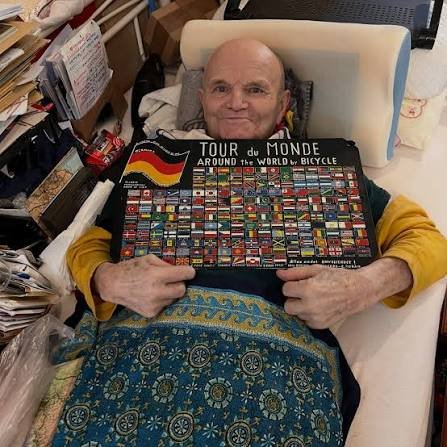
Heinz Stücke was not a digital nomad. He had no laptop, no smartphone, no Instagram and no online income. He had a bicycle, a tent, maps, a camera and an almost endless desire to see the world.
What was originally planned as a two-year journey eventually became 51 years on the road. During that time, Heinz Stücke travelled approximately 648,000 kilometres and visited 196 countries, according to published accounts.
In July 2026, Heinz Stücke died at the age of 86 in his hometown of Hövelhof, Germany.
His story is therefore not simply the story of an extraordinary cyclist and traveller. It is also the story of a form of nomadic life that existed long before smartphones, Wi-Fi, online businesses and social media.
Nomadism was not invented by the internet.
A Young Man Who Simply Left
Heinz Stücke was born in 1940 in Hövelhof, Westphalia, Germany. He trained as a toolmaker and initially worked a conventional factory job.
But from a young age, he wanted to see the world.
At the age of 18, he made his first major journey. In 1958/59, he travelled around the Mediterranean and eventually returned home to Hövelhof.
He went back to the factory and worked as a toolmaker again.
But he did not stay there for long.
In August 1960, he left again. This time, he even sold his Volkswagen Beetle and travelled as far as India. When he ran out of money, he temporarily worked aboard a Norwegian ship.
Through Singapore and the Soviet Union, he eventually made his way back to West Germany.
He was already someone who repeatedly chose to leave the familiar behind.
1962: The Journey That Was Supposed to Last Only Two Years
In 1962, at the age of just 22, Heinz Stücke left Hövelhof once again.
This time he had a specific plan:
He wanted to cycle to Tokyo for the 1964 Olympic Games.
After that, he intended to return home.
But that is not what happened.
He did not reach Japan until 1971 – nine years after setting off.
There was simply too much to see, too many people to meet and too many countries to explore.
At some point, his idea of the journey changed.
He no longer needed to reach a particular destination.
The journey itself became his life.
51 Years on the Road – But Not 51 Years of Continuous Cycling
One important detail of his story is sometimes misunderstood.
When people say that Heinz Stücke spent 51 years travelling around the world, this does not mean that he cycled every single day for 51 years.
It means that from 1962 until his return in 2014, he lived predominantly as a traveller and nomad.
He became ill, spent time in hospitals, travelled by ship on some occasions and inevitably had periods when cycling was interrupted by repairs, border formalities and other circumstances.
But one fact is particularly remarkable:
After leaving Hövelhof in 1962, he did not return permanently to his hometown until 2014.
He was not someone who simply spent a few months travelling each year before returning home.
For example, his family met him for a weekend in Arnhem in the Netherlands in 1977. His final return to Hövelhof came only in 2014.
That makes the 51 years even more extraordinary.
648,000 Kilometres on Two Wheels
The figures associated with Heinz Stücke seem almost unreal:
- 51 years on his world journey
- approximately 648,000 kilometres
- 196 countries
- 21 passports
- more than 100,000 photographs and slides
- countless personal encounters
- one bicycle that accompanied him for decades
From 1995 to 1999, Stücke was even listed in the Guinness Book of Records as the most travelled man in history.
Yet the journey itself appears to have mattered more to him than the record.
His attitude was remarkably simple:
He simply kept cycling.
The Bicycle That Accompanied Him for Decades
Heinz Stücke did not ride a modern expedition bicycle.
No carbon frame.
No electronic gears.
No GPS.
No smartphone navigation.
His bicycle was a Torpedo three-speed bicycle made by the former Paderborn manufacturer TriePad.
That bicycle became one of the constants of his life.
The frame was repaired again and again. According to Stücke’s own accounts, the bicycle was also stolen six times – and he recovered it every time.
The bicycle was much more than a means of transportation.
It became his identity.
A world map showing his route was attached to the bicycle. When people saw him, they immediately knew that this was not an ordinary tourist.
How Did Heinz Stücke Finance His Life?
This is probably one of the most fascinating questions about his story.
Because even a minimalist nomad needs money.
He needed food.
He needed spare parts.
He needed clothing.
And occasionally he had to pay for transportation or other necessities.
His solution was surprisingly modern – even though it worked entirely without the internet.
He turned his journey itself into content.
His Journey Became His “Content”
Heinz Stücke wrote a booklet containing stories and anecdotes from his travels.
What began as only a few pages eventually became a publication of around 20 pages.
People could read the booklet and pay whatever they wanted for it.
Sometimes he received only a few cents.
At other times, people gave him considerably more – according to his own accounts, sometimes as much as 200 euros for a booklet.
In a strange way, Heinz Stücke had created something that sounds remarkably similar to a modern creator economy:
Experiences became stories.
Stories became content.
Content generated income.
There was simply no website, blog or social media platform involved.
He Sold Stories to Newspapers
Stücke also sold stories to newspapers and presented his journey to German clubs and audiences.
His photographs became another source of income.
A British agency sold photographs from his travels.
In Japan in 1972, he reportedly earned around US$20,000 from lectures and his story. According to his own account, that money lasted him for several years.
In an interview, Stücke also said that over the entire 51-year period he may have worked for only three or four months in the conventional sense.
His “job” was ultimately:
travelling, observing, photographing, writing and telling stories.
He Needed Surprisingly Little Money
According to later reports, Stücke initially had only about US$300 with him.
He lived extremely frugally.
When he was hungry, he did not necessarily go to a restaurant.
Sometimes he simply waited until people noticed that he needed help.
Many people invited him into their homes for food.
The heavily loaded bicycle made a difference.
It was obvious that he was not a wealthy tourist.
He was a traveller living with very few resources.
And that often led people to help him.
The Emperor Who Gave Him $500
One of the strangest episodes of his journey took place in Ethiopia.
Stücke was almost out of money.
Then he met Haile Selassie, the Emperor of Ethiopia.
According to accounts of the encounter, the Emperor invited Stücke and gave him US$500.
For a young cyclist travelling on a tiny budget, that was an enormous amount of money.
Today, such an encounter would probably be photographed, posted online and shared around the world.
Heinz Stücke had neither a smartphone nor social media.
The story spread anyway.
Back then, stories travelled from person to person.
Travelling the World Without Google Maps
Today, travelling around the world without the internet seems almost impossible to many people.
We open Google Maps.
We search for accommodation.
We translate signs.
We check timetables.
We book buses and flights.
We check borders and opening hours.
We tell our friends where we are.
Heinz Stücke had none of this.
He had maps.
And most importantly, he had something that can sometimes be overlooked today:
He had to ask people.
If he did not know the way, he asked someone.
If he needed somewhere to stay, he talked to people.
If he did not know how to continue, he had to find a solution locally.
His world journey was therefore much more direct and personal.
The Nomad Before the Digital Nomad
Today, the term digital nomad is everywhere.
It usually describes people who can work independently of location because of digital technology.
They program from Thailand.
Run marketing businesses from Portugal.
Write articles from cafés.
Work for clients in other countries.
Earn their money online.
This is a modern form of nomadism.
But it is only one form.
Heinz Stücke was a nomad long before the digital nomad existed.
He did not need Wi-Fi to live on the road.
He did not need an online business.
He did not need a laptop.
He had no digital income.
His means of transport was his bicycle.
His communication platform was face-to-face conversation.
His content was made up of stories, photographs and experiences.
So What Is the Difference?
| Heinz Stücke | Digital Nomad Today |
|---|---|
| Bicycle | Plane, bus, train, van or bicycle |
| Paper maps | Smartphone and GPS |
| Travel booklet | Blog, YouTube, social media |
| Photographs and slides | Smartphone camera and cloud storage |
| Newspapers | Online media |
| Lectures | Podcasts, videos and livestreams |
| Personal contacts | Messengers and social networks |
| Cash | Bank cards and online banking |
| Maps and asking people | Navigation apps and search engines |
| Hospitality | Booking platforms and digital communities |
The technology has changed.
But the underlying desire is remarkably similar:
to experience freedom, discover new places and avoid tying one’s entire life to a single location.
Nomadism Existed Long Before the Internet
The term “digital nomad” is modern.
Nomadism itself is ancient.
People travelled long before computers, cars and aeroplanes existed.
Heinz Stücke was not living like an ancient nomad, of course. He was a modern man of the 20th and 21st centuries.
But his life demonstrates something very clearly:
Technology can enable nomadism – but technology is not a prerequisite for it.
The internet makes many things easier.
It makes location-independent work possible.
It makes communication easier.
It simplifies travel planning.
But it did not invent the desire to be on the road.
Minimalism Was Not a Lifestyle Trend for Him
Today there are countless books, blogs and videos about minimalism.
People count their possessions.
They buy special backpacks.
They search for the perfect lightweight tent.
They wonder whether they can live with 10, 20 or 30 possessions.
Heinz Stücke did not need to think about minimalism in those terms.
If your entire life has to be transported on a bicycle, the question answers itself.
Anything you do not need stays at home.
His minimalism was not an aesthetic concept.
It was practical.
Every extra kilogram had to be moved by his own legs.
But His Life Was Not Just Freedom
It is important not to romanticise Heinz Stücke’s life.
Fifty-one years on the road did not mean 51 years of holiday.
He became ill.
In Iran, he contracted typhoid and had to go to hospital.
In Zambia, he was shot in the toe by armed separatists.
His bicycle was stolen several times.
The frame had to be repaired repeatedly.
Borders, authorities, political situations and poor roads sometimes made his journey extremely difficult.
And of course, a life like this could also be lonely.
Stücke often travelled alone.
He did not have a permanent home to return to after a difficult week.
His freedom came with a price.
Why Didn’t He Simply Go Home?
This may be the key question behind his entire life.
Stücke did consider returning to Germany at various points.
But each time, something drew him onward.
Another country.
Another road.
Another encounter.
Another story.
And eventually, being on the road became normal.
Going home became the unusual thing.
At some point, the journey was no longer something he was doing.
The journey was who he was.
51 Years Later: The Return Home
In 2014, the journey finally came to an end.
After 51 years on the road, Heinz Stücke returned to Hövelhof.
He was 74 years old.
He had travelled approximately 648,000 kilometres and visited almost every part of the world.
The municipality provided him with a small apartment.
And suddenly, the man who had spent decades travelling had to organise an entirely different kind of life.
An Apartment Full of World History
Stücke brought home an extraordinary collection:
- more than 100,000 photographs and slides
- maps
- travel documents
- bicycle equipment
- gifts
- souvenirs from around the world
- notes and stories
His small apartment became a kind of personal world-travel archive.
After his death, German broadcaster WDR reported on the enormous collection of photographs and memorabilia he had accumulated during his decades of travel.
His life was no longer out on the road.
It was now stored in boxes, photographs, maps and memories.
The End of an Extraordinary Journey
Heinz Stücke died in July 2026 at the age of 86 in Hövelhof.
The town he had left in 1962 was also the place where his extraordinary life eventually came to an end.
He had not simply taken a world trip.
He had turned the world trip into his life.
What Heinz Stücke Can Teach Today’s Nomads
1. You do not necessarily need much
The less you own, the easier it is to move. Stücke had to carry practically everything he owned, so he had no choice but to travel light.
2. Money is important – but it is not the only resource
Stücke earned money from booklets, stories, photographs and lectures. At the same time, hospitality and the generosity of strangers helped him enormously.
3. Location-independent life existed before the internet
The internet revolutionised travel and remote work. It did not invent the idea of living on the move.
4. Stories can have value
Stücke had something people wanted to hear about. His experiences became stories, and those stories became a source of income.
5. Freedom does not mean that everything is easy
Living on the road can provide freedom, but it also means giving up some security, comfort and predictability.
Heinz Stücke Was an Analog Nomad
Perhaps the simplest way to describe his life is with a term that did not exist during most of his journey:
He was an analog nomad.
His tools were not laptops, smartphones and Wi-Fi.
His tools were:
- a bicycle
- a map
- a camera
- a notebook
- his stories
- his curiosity
- and the willingness to talk to strangers
Today, someone can sit in a café in Cape Town and work for a company in Berlin.
Heinz Stücke could not do that.
But he could arrive somewhere, talk to people, tell his story and continue cycling the next morning.
That was also location-independent living.
Maybe a Nomad Does Not Need the Internet at All
This may be the most interesting question left by his life.
What actually makes someone a nomad?
Is it a laptop?
An online business?
A certain number of countries?
A van?
A backpack?
Or is it simply the decision not to tie your entire life to one place?
Heinz Stücke did not answer that question theoretically.
He simply lived the answer.
For 51 years.
On a bicycle.
Without the internet.
Without a smartphone.
Without an online business.
And with a world that could still surprise him every single day.
His Real Legacy
648,000 kilometres are impressive.
196 countries are impressive.
Spending 51 years on the road is extraordinary.
But perhaps those numbers are not the most important part.
The most interesting lesson from Heinz Stücke’s life may be this:
You do not have to live according to the possibilities of your time.
When Stücke left Germany, there were no smartphones, GPS devices, mobile internet or social networks.
And yet he managed to create a life that many people today would describe as the dream of a digital nomad.
He simply did it in a completely different way.
He had no Wi-Fi.
He had no apps.
He had no followers.
He had the world.
And perhaps that is exactly why his story remains so fascinating in the digital age.
Frequently Asked Questions About Heinz Stücke
Who was Heinz Stücke?
Heinz Stücke was a German bicycle traveller from Hövelhof. In 1962, at the age of 22, he set off on what was originally planned as a two-year journey to Tokyo. He eventually spent 51 years travelling.
How long was Heinz Stücke travelling?
His great world journey lasted from 1962 until 2014 – approximately 51 years. He did not return permanently to his hometown of Hövelhof until 2014.
How many kilometres did Heinz Stücke travel?
Published accounts put the total at approximately 648,000 kilometres.
How many countries did Heinz Stücke visit?
He stated that he had visited 196 countries. Different sources may give slightly different numbers depending on whether territories and disputed entities are included.
How did Heinz Stücke finance his world journey?
He earned money by selling travel booklets, stories and photographs and through lectures and appearances. Hospitality from people he met on the road was also an important part of his ability to live cheaply.
Did Heinz Stücke have an online income?
No. His great journey began in 1962, long before the internet existed. He relied on analogue forms of publishing, photography, lectures and personal contacts.
What bicycle did Heinz Stücke ride?
He rode a Torpedo three-speed bicycle made by the former Paderborn manufacturer TriePad. The bicycle accompanied him for decades and was repeatedly repaired.
How many times was his bicycle stolen?
According to his own accounts, his bicycle was stolen six times. He recovered it every time.
When did Heinz Stücke return to Germany?
He returned to Hövelhof in 2014 after 51 years on the road. This does not mean that he cycled continuously for 51 years. There were illnesses, hospital stays, ship journeys and other interruptions. But he did not simply return home regularly for extended periods; his permanent return to Hövelhof came in 2014.
When did Heinz Stücke die?
Heinz Stücke died in July 2026 at the age of 86 in Hövelhof, Germany.
Was Heinz Stücke a digital nomad?
No. He lived and travelled decades before digital nomadism became a modern concept. His life demonstrates that nomadic living does not depend on the internet.
Sources and Further Reading
The biographical information in this article is based on published interviews with Heinz Stücke and later reporting about his life and legacy.
DER SPIEGEL: Heinz Stücke – 648,000 kilometres and 196 countries
Responsive CSS