Rice from a Dog Bowl: An Encounter in Angola That Changed My View of Poverty, Waste, and Life in Africa
There are moments while traveling that cannot be captured in photos. Moments that no Instagram post could ever capture, because they are too uncomfortable, too honest, too human. This article is about one such moment. A moment that stayed with me for days. A moment that forced me to put my own worldview to the test.
I am not writing this text to shock. I am not writing it to evoke pity. I am writing it because I believe that it is precisely these kinds of encounters that make traveling off the beaten path so valuable – and because I believe that you, dear reader, might share similar questions with me after reading this text.
Sit with me. Let us walk through this scene together, and through the thoughts it triggered in me.
The Scene: A Dog Bowl, Rice, and a Quiet Moment
It was an ordinary day in Angola. The air was heavy, humid-warm, with that typical smell of dust, fried food, and salty sea air that settles over the streets. My dog – my faithful companion on this journey – had, as every day, received his bowl of rice and some meat. Nothing special, nothing luxurious. Just what was available for him that day.
I was briefly distracted. Maybe I reached for my phone, maybe I sorted a few things, maybe I just enjoyed the moment, lost in thought, when there was nothing in particular to do. Those little pauses in daily travel life when you just are.
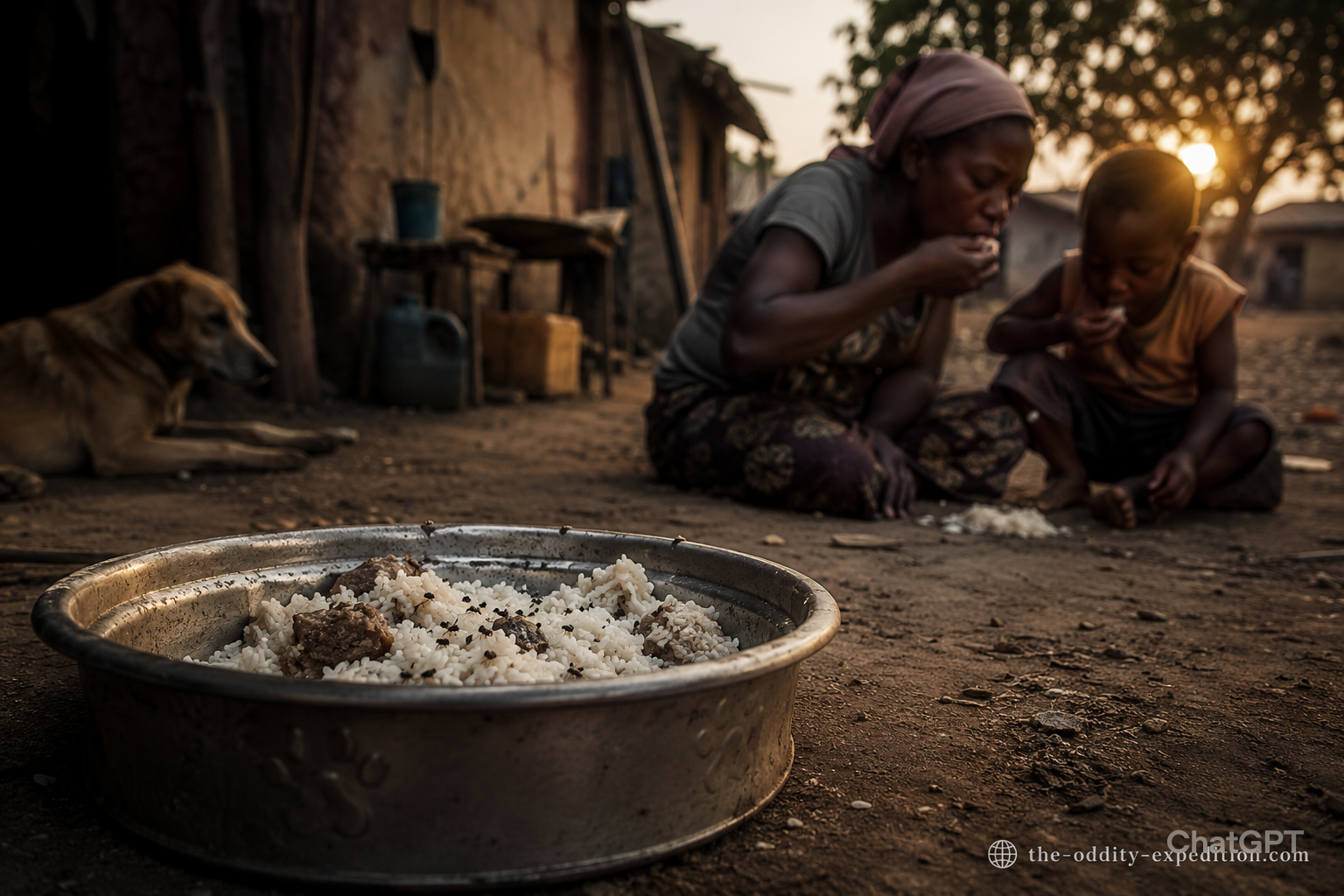
When I looked up, I saw a woman who works here, and her little son. They were sitting next to my dog’s bowl. They were eating from it. Rice and meat – from my dog’s bowl.
I couldn’t react quickly enough.
My first glance fell on the rice. It was full of tiny beetles. Not just one that had fallen in – no, the rice was thoroughly infested. And yet they ate. Calmly. Without haste. Without visible shame, without visible discomfort.
Have you ever imagined how you would react in such a moment? I had never imagined it. You simply don’t imagine something like that before it happens.
My Initial Shock
I want to be honest – my first impulse was shock. A deep, physical shock that pulled through my stomach like a wave. Not disgust in the classic sense, but something more complicated. A mixture of bewilderment, helplessness, and a feeling I couldn’t initially name.
Rice full of beetles. From my dog’s bowl. A mother and her child.
Thoughts raced through my head. Should I say something? Should I immediately offer them something else? Should I pretend I hadn’t seen anything, to avoid making the situation even more uncomfortable for them, if they even felt uncomfortable at all?
And then – almost instantly – came the second thought, which occupied me even more than the first: Why does this shock me so much?
What exactly was it that hit me so deeply? Was it the sight of the beetles in the rice? Was it the fact that it was my dog’s bowl? Or was it something much larger – the sudden, unavoidable confrontation with a reality so far removed from my own that I didn’t even have the right words for it?
I believe it was a mixture of everything. But above all, it was one thing: a mirror. A mirror that held up my own life, my own standards, my own – yes, I’ll say it as directly as I felt it – privilege.
Why I Began to Question My Own Perspective
In the hours and days after this scene, I couldn’t stop thinking about it. I turned the situation over and over in my mind, like a stone you examine from all sides to understand what it really is.
What does it actually mean when we say, “I would never eat that”? Who decides what is edible and what is not? Who decides where the boundary between “human food” and “animal food” lies?
In Europe, this boundary is inviolable, almost sacred. Dog food is dog food. Human food is human food. This distinction is so self-evident to us that we never question where it even comes from.
But is this distinction universal? Or is it a luxury? A luxury you can only afford when you have enough – enough choice, enough security, enough abundance to even allow yourself categories like “this is only for animals”?
I began to understand: My reaction was not wrong. But it was also not “the truth.” It was my truth, shaped by my origin, my upbringing, my wealth, my access to clean, sorted, packaged food that never comes into contact with insects before it lands on my plate.
Have you ever wondered how much of your own morality is actually just a question of wealth?
Waste and Wealth: A Look at Our Own Daily Lives
Let’s change our perspective for a moment. Let’s not look at Angola, but into our own kitchens. Into our own refrigerators.
How often have we thrown away food because it “looked weird”? How often have we disposed of bread because it was a day old? How often have we thrown leftovers in the trash because “it’s not worth eating this anymore”?
In Europe, expiration dates are often treated as law, not recommendation. A yogurt that is one day past its date ends up in the trash – even though it would be perfectly fine. An apple with a brown spot is thrown away instead of cutting out the spot. Leftovers from the day before? Some people would never eat them again.
We live in a world where food waste in the wealthy countries of this world has reached massive proportions – while simultaneously millions of people do not have enough to eat. This discrepancy is not abstract. It is real. And it became more tangible for me in that one moment in Angola than ever before.
Was the rice in my dog’s bowl “waste”? For me – perhaps. For the woman and her son – it was food. Was it “wasted”? Or was it simply… there? Available? Edible, despite the beetles, because hunger forces a different prioritization than disgust?
I don’t want to preach to anyone here. I also throw things away. I also have standards that I don’t want to abandon and don’t have to. But this moment showed me how relative these standards actually are – and how little we are aware of this in our daily lives.
What Poverty Really Means – Beyond Clichés
When we talk about poverty in Africa, many people in Europe immediately have images in their heads. Images of donation campaigns, of outstretched hands, of children with sad eyes. These images are not wrong – but they are incomplete. And often they are also dehumanizing, because they reduce poverty to a single, flat image.
What does poverty really mean? Is it just the lack of money? Or is it something more complex – the lack of choices?
The woman I had observed probably had no other choice in that moment. Or perhaps she had a choice, but the cost-benefit calculation looked different for her than it would for me. Perhaps it was simply: Here is food. It is available. My child is hungry. The beetles? A side issue, not an obstacle.
For me, with my European background, with my access to supermarkets, to running water, to medical care, to a social safety net that would catch me if necessary – for me, this situation would be unthinkable. But that is precisely the point: My unthinkability is a privilege. Not a moral advantage. A privilege.
Poverty is not just an empty wallet. Poverty is often also the constant, daily adaptation to what is available – without the ability to be choosy. It is the normalization of circumstances that would be unimaginable for someone with other options.
And yet – and this is particularly important to me – there was no desperation to be seen in this scene. No drama. No tragedy, as I might have expected. It was… everyday life. Pragmatism. A calmness that touched me almost more than any desperation would have.
Other Perspectives on Food, Resources, and Waste
The longer I travel in Africa – and by now it has been months spanning various countries in West and Central Africa – the more I understand that our European perspective on food is just one of many.
In many parts of the world, the idea that food becomes “bad” once it exceeds a certain appearance or date is simply not the primary concern. The primary concern is: Is it still edible? Does it make you sick? Does it satisfy hunger?
Beetles in the rice – for many people worldwide, this is not a reason to throw away an entire meal. You remove what you can, and eat the rest. This may sound strange to European ears, but is it really so absurd? Insects are already part of the diet in many cultures – as a conscious protein source, not just as unintended bycatch.
Why don’t people throw away food, even when it seems “unappetizing” to us? Perhaps because the act of throwing away itself is a luxury. An act that presupposes that more is available. That you can afford not to eat something.
This other perspective on food is not “backward” or “primitive” – terms I deliberately avoid because they carry precisely the arrogance I don’t want in this article. It is simply a different logic. A logic that has emerged from different life realities.
And perhaps – this is a thought that has stayed with me since – our logic is not “the right one.” It is just one of many. Shaped by abundance, by industrialization, by an almost excessive safety culture around food.
Encounters That Make You Think
Traveling off the tourist routes means you cannot avoid such moments. You cannot click them away, skip them, or pass them by in an air-conditioned bus.
This encounter with the woman and her son was for me exactly that: an encounter that makes you think. Not because it was spectacular. But because it was so unspectacular. Because it showed what daily life looks like for millions of people – a daily life that often remains invisible to me as a traveler until I am directly confronted with it.
I often ask myself: How many such moments are there that I do not see? How many realities exist parallel to my own, without me ever noticing them, because I don’t look, because I don’t allow myself to look, or because I am simply too busy with my own daily life?
Travel changes your view of the world – but only if you do not close yourself off to these moments. Only if you are willing to endure uncomfortable feelings without immediately finding a box for them. “Poverty,” “tragedy,” “pity” – these are boxes. And boxes help us to quickly put away difficult things without really understanding them.
In that moment, I did not want a box. I wanted to understand.
What I Learned from This Encounter
This encounter taught me several things – things that I can now formulate more clearly, some time later, than in the moment itself.
First: My reaction – the shock – was not wrong, but it was culturally conditioned. It says more about me than about the situation itself.
Second: Poverty is not a homogeneous experience. It has a thousand faces, a thousand ways of dealing with it. Some people experience it with desperation, some with dignity, some – as in this case – with a matter-of-factness that was almost impressive.
Third: Waste is relative. What is “garbage” or “animal feed” to me can be a full meal for someone else. This realization has changed my own handling of food since then – not out of guilt, but out of genuine awareness.
Fourth: I don’t have to judge. I don’t even have to understand, in the sense of “being able to fully comprehend.” It is enough to acknowledge that this reality exists – alongside my own, equal, without hierarchy.
And fifth, perhaps the most important: This kind of encounter is exactly what I travel for. Not for the most beautiful beaches, not for the most spectacular sunsets – but for these quiet, uncomfortable, honest moments that force me to expand my own worldview.
Reflective Conclusion: Gratitude, Perspectives, and the Power of Travel
I thought for a long time about whether to write this story at all. It is personal, it is uncomfortable, and I did not want it to sound like a story about “the poor in Africa” under any circumstances, told from the superior position of a European traveler.
But that is precisely why I believe it needs to be told – not despite, but because of its discomfort.
What remains in the end? Gratitude – yes, but not the kind of gratitude that says with a raised index finger: “Be grateful for what you have, look how bad others have it.” But a quieter, more honest gratitude. The gratitude for having a choice. For being able to have standards. For being able to think about expiration dates because I have never truly gone hungry.
And at the same time, a deep humility remains. The realization that my way of living is not the standard by which everything else should be measured. That there are so many ways of dealing with life, with scarcity, with resources – and that none of them is per se “better” or “worse,” but simply… different. Shaped by circumstances that I may never fully understand.
Traveling off the beaten path means exposing yourself to these moments. Observing yourself, how you react, what shocks you, what touches you – and why. It means recognizing your own perspective not as the truth, but as one of many possible perspectives.
This one scene – a woman, her son, a dog bowl, rice full of beetles – moved more within me than many a “big” travel experience. It did not change me in the sense of a dramatic turning point. But it shifted something within me. A small but lasting shift of the inner map.
And perhaps that is the greatest gift that travel can give us: not the spectacular places, not the perfect photos – but these quiet moments that show us how large and diverse the world really is. And how small, how limited our own view of it often is, until we are ready to expand it.
The next time you throw something away because it “doesn’t look good enough anymore” – perhaps think of this story for a moment. Not with guilt. But with awareness. With the quiet reminder that value, waste, and need are defined differently all over the world – and that none of these definitions is the only valid one.
This is what The Oddity Expedition means to me: not just traveling to places, but traveling perspectives. And sometimes it is precisely the most uncomfortable encounters that teach us the most about life – about life in Africa, about life everywhere, and about our own.
Have you ever had an encounter while traveling that changed your view of the world? I look forward to you sharing your thoughts and experiences in the comments.